16 July 2024

Catch22 discusses how young adult hubs can deliver better outcomes for young adults in the criminal justice system and why this approach should become standard practice.
Catch22 specialise in delivering services which build resilience and aspiration in individuals and communities across the UK. Our justice services provide young people and adults with interventions, rehabilitative support and victim services in prisons and in the community – all with the overarching aim of supporting positive transitions through and away from the criminal justice system (CJS).
A relational approach
Over 100 years of service delivery has taught us that the best way of securing positive outcomes for people in the CJS is by building strong relationships which focus on the bespoke needs of the individual. There is no one size fits all solution when it comes to rehabilitation. This is especially true for young adults in the CJS, who we know are overrepresented in the system.
At this key age, young adults are experiencing so many profound transitions, positioning them at a pivotal moment in deciding their future. Such a relational approach is fundamental to redirecting their life-path away from one of crime. Indeed, we know that loss of positive relationships is a key driver of crime in the first place, and positive relationships with practitioners can protect against violence.
Newham Youth 2 Adulthood (Y2A) Transition Hub
Since April 2024, Catch22 have been part of a multidisciplinary team, commissioned by the MoJ and MOPAC and co-located with Probation, to deliver a holistic mentoring service in Newham, called the Newham Youth 2 Adulthood (Y2A) Transition Hub. Our work supports young adults aged 18-25 on probation in Newham, and 17-year-olds who are transitioning from the youth justice system to adult probation.
Our caseworkers focus on building trusting relationships with the young people referred into the service through a developmentally appropriate and maturity informed approach. In other words, this means assessing young adult social, emotional and intellectual development and tailoring engagement to meet their needs, as opposed to basing assessment solely on their biological age.
Why are we passionate about this approach?
The 17-25 year old cohort in the CJS is unique and presents very specific needs. Many of the young people on Probation have experienced significant trauma, have mistrust of the system or are vulnerable in one way or another.
It’s clear that there’s not enough being done to provide young adults with the required level of support, opportunities and aspirations for them to make long-term positive changes. In fact, we see many thousands of young people enter the justice system and never leave – going on to lead a “revolving door” life in and out of the CJS throughout their adulthood.
Whilst it is recognised by the CJS that a maturity informed approach is required, the system is yet to fully embed a tailored, end-to-end approach which responds to the bespoke needs of young adults, acknowledging brain development, maturity and focusing on enabling positive change and progression.
This is exactly what the Newham Y2A Hub seeks to address. The Y2A hub takes a multi-agency, place-based approach to supporting the young adult cohort. By creating a safe, age appropriate, supportive environment, as well as access to additional support services (such as accommodation, therapy and emotional wellbeing) all under one roof, the Y2A Transition Hub enables young adults to build positive working relationships with professionals and reignite trust in the system. Most importantly, it gives them the tools and motivation to lead a positive, pro-social life as they enter adulthood.
Future Focus
Early evidence suggests that the multi-agency, relational approach adopted within the Newham Y2A Hub is effective in supporting positive transitions and creating hope for a brighter future amongst young adults in the CJS. Looking forward, we want to see this approach embedded as standard practice across the sector. Investment in the implementation of similar relational-based support services will have long-term impacts across the CJS, not least in reducing recidivism.

Greater Consideration of Maturity: A New Vision for Young Adult Sentencing
Read more 9 July 2024
Gradually or suddenly? Changing attitudes to young adults in the magistrates’ courts
Young adults
Fionnuala Ratcliffe, Research and Policy Lead at Transform Justice, shares some insights from their recent report on how young adult maturity is considered in the magistrates’ court.
“How did you go bankrupt?”
“Two ways. Gradually, then suddenly.”
This Ernest Hemingway quote has been on my mind this week in relation to achieving behaviour change in the magistrates’ courts.
The Barrow Cadbury Trust has long been advocating for a distinct approach to young adults in the criminal justice system. Their work has led to some significant changes in policies in the magistrates’ courts. The sentencing guidelines set out how ‘age and/or lack of maturity’ can affect a person’s responsibility for the offence. Prosecutors are guided to consider maturity in their charging decisions, as is the probation service in its pre-sentence reports.
What difference have these maturity policies and guidelines made in court? That’s where Transform Justice’s CourtWatch London programme came in. We recruited and trained volunteer members of the public (courtwatchers) to observe local magistrates’ courts hearings and write down what they saw.
82 courtwatchers reported on over 1,100 hearings between them with just under 200 involving young adult defendants. One area we asked them to focus on was maturity. What was said about young adults’ maturity? What impact did it have on the court’s decision making?
How is maturity discussed and considered in the magistrates’ court?
Courtwatchers reported that maturity is not even mentioned most of the time, let alone considered. In two thirds of young adult hearings, maturity was not discussed in open court, even though courtwatchers often felt it was relevant: “I found it puzzling that the defendant’s age wasn’t used in the defence strategy. He was clearly young and quite scared in the dock.” Where it was raised, it was usually briefly and generically, as part of a long list of factors. One courtwatcher described the mentioning of maturity as a “tick box” exercise.
There were some examples of court professionals raising maturity in a considered way. In one case, a young Romanian man had been charged with stealing over £1,000 of alcohol from a supermarket. The prosecutor made a detailed case for taking the young adult’s developing maturity into account: “He used a report on the precarious position of young adults in society, especially emphasising the ineffectiveness of viewing them as adults as soon as they turn 18. Using the research, he emphasised the growth still needed and urged leniency.”
In a very small number of cases (not the one above, unfortunately), maturity arguments prompted the court to reduce sentence length, or at least adjourn for further information. But usually comments on maturity were dismissed by court decision makers or deprioritised over other factors.
Why isn’t maturity featuring in magistrates’ court decision-making?
What to make of this absence of maturity from court discussions? We brought the findings to a group of stakeholders at a roundtable on the 4th of June. Everyone was supportive of young adults being treated differently by the courts, but the group felt there were several barriers to this happening in practice.
Training could be improved so that everyone – magistrates, district judges, prosecutors and defence lawyers – understands maturity and why it matters. Magistrates currently have no mandatory training on maturity, so this should be incorporated into their core training. CPS training and guidance does cover maturity but, as our report shows, prosecutors aren’t doing much better than magistrates.
Maturity is also difficult to define and there is no tried and tested assessment tool. A dedicated probation officer with enough time could do a good job of outlining how the young adult’s maturity was a factor in the offence and the implications for sentencing. But probation services are under-resourced and so this rarely happens.
Roundtable attendees also felt maturity could be seen as vague, compared to other factors such as mental health and drugs where the available interventions are clearer. Courtwatchers picked up on this too: “I did not feel magistrates felt convinced about argument on defendant maturity. They took more interest in the doctor’s report on depression and the defendant being his mother’s carer.”
Mentioning maturity could also have a backfire effect – if a judge hears a young man is immature and therefore more susceptible to negative influences through peer pressure, a judge may be more likely to see him as ‘risky’.
Suddenly not gradually? Towards a young adult court
Better assessment, training and staffing could all help magistrates’ courts take a more considered approach to young adult hearings and maturity. Courtwatchers did witness some good practice from the courts, and there is scope to build on this progress.
But changing the mindsets of every professional and magistrate in the adult court system is a long and gradual slog. Can we improve how young adults are treated via a different route?
A more radical option is to grow the remit of the youth court, where the mindsets around maturity have already shifted. The youth court has ‘child first’ principles where courts are told to ‘prioritise the best interests of the child’ and focus on building a ‘pro social identity’. Magistrates, prosecutors and lawyers all have specialist youth court training meaning they have a much better understanding of low maturity and its consequences.
In the foreword for our report, Rob Allen (former T2A Alliance Chair) advocates for raising the age of people dealt with in the youth court beyond the age of 17. A small step towards this could be to hold young adult hearings one afternoon after the youth court sits in the morning. Young adults would then benefit from the expertise and training of youth court magistrates, aided by youth specialist prosecutors and defence lawyers, whose workload has reduced over the years since (thankfully) fewer children are brought to court.
A pilot young adult court would introduce some complexities around court listings, so it would need to be trialled in one area where the court service is willing to give it a go.
This may strike some as quite a radically different approach, but we’ve tried gradual – perhaps it’s time for something else.

Our sons and daughters: Is maturity considered in the magistrate’s court?
Read report 4 June 2024
What does research tell us about young adults in the justice system and trauma?
Trauma, Young adults
Georgia Barnett is a psychologist and researcher, and partner at KTA Research and Consulting who specialise in bringing evidence into criminal justice practice. Georgia worked for HMPPS for 22 years, and spent the last 10 years working in the HMPPS Evidence-Based Practice Team. Georgia has written a series of shorts blogs for T2A, providing a snapshot of the young adult evidence base.
What do we mean by trauma?
There isn’t a single agreed definition of trauma, but experts say this involves both events that are experienced as extremely harmful and an adverse reaction to those events that has long-lasting, negative impacts that get in the way of a person’s normal functioning.
What do we know about trauma and young adults in the justice system?
A 2017 report by Beyond Youth Custody looked at published research and reports about trauma among young people in the criminal justice system and found:
- Trauma is more common in young adults in prison than in the general population.
- Common types of trauma among young adults in prison include the experience of childhood abuse, loss, victimisation, mental health issues and brain injury.
- Women are more likely than men in prison to have suffered a range of trauma, including sexual abuse and family violence.
- Trauma is more common in the histories of people who display aggression, engage in antisocial or offending behaviour, including violent or sexual offending, who gamble, and who misuse substances, than those who don’t engage in these behaviours.
- Trauma makes it more likely that individuals will suffer from certain mental health difficulties including depression and Post Traumatic Stress Disorder, and more generally, from anxiety and stress, and perceptions of low self-worth.1
More recent research based on interviews with young adults serving long sentences in England suggests that those who have previously experienced trauma find life in prison more challenging than their peers.2 This research also found that young adults serving long prison sentences can find it difficult to talk about trauma because they might not want to admit or show vulnerability, might not see adverse experiences as traumatic, have problems with memory about childhood events, or don’t have the language or emotional literacy to talk about this issue.
What can we do to support young adults experiencing the effects of trauma?
Research with young adults in prison suggests that we should:
- recognise that young adults may have experienced trauma themselves as result of their offending behaviour. When encouraging young adults to talk about trauma, it might be more helpful to identify, explore and work on the causes of specific issues that could stem from trauma, like sleep or appetite problems.
- recognise and work on issues with self-compassion, loss, and grief.
- be careful not to judge risk and need prematurely, as denial of risk and harm can be a way young adults might cope with their sentence. Adjustment to long sentences could be particularly difficult for those young adults who have a history of trauma.
- use a strengths-based approach which makes the most of existing strengths, and builds resilience, support systems, and new, helpful ways of coping.
- meet the young adults where they are, understanding and working with rather than against any apparent resistance or lack of motivation to engage, and working at a pace that helps them to change and develop.
- ensure people working with young adults have a good knowledge of the impact of trauma and aim to use trauma-informed practices which focus on creating safe, predictable environments, and strong, trusting relationships.
- involve partner agencies (e.g., social services and mental health services) to provide co-ordinated, integrated and holistic care.
Trauma-informed practice (TIP) is an approach that could help young adults in prison or on probation. TIP means staff are aware of and skilled in responding appropriately to how trauma might impact on how someone feels or behaves, and that organisational cultures and practices do not allow a person’s trauma to get in the way of their access to services.3 TIP usually involves: 1) creating a sense of safety, 2) building and maintaining trust in the organisation and in relationships, 3) giving choice, 4) collaborating, 5) empowering the individual, and 6) being inclusive.4
More information and free resources about working with trauma, and trauma informed practice are available from Intermediaries for Justice and the Youth Justice Resource Hub.
- Beyond Youth Custody (2017). Trauma and young offenders – a review of the research and practice literature. Trauma-and-young-offenders-a-review-of-the-research-and-practice-literature.pdf (beyondyouthcustody.net) ↩︎
- O’Rourke, R. (2022). The nature and impact of trauma in young adult male prisoners: screening for trauma and exploring the experience both past and present. Available at: https://irep.ntu.ac.uk/id/eprint/473 ↩︎
- Petrillo, M., & Bradley, A. (2022). Working with Trauma in Adult Probation: HMIP Research and Analysis Bulletin 2022/02. Available at: Working with trauma in adult probation (justiceinspectorates.gov.uk) ↩︎
- Bradley, A. (2021). Viewing Her Majesty’s Prison Service through a trauma-informed lens. Prison Service Journal, 255, 4-11. ↩︎

Young Adult Evidence Snapshot
What does research tell us about young adults from ethnic minorities in the justice system?
Read more 4 June 2024
What does research tell us about building positive relationships with young adults?
Young adults
Georgia Barnett is a psychologist and researcher, and partner at KTA Research and Consulting who specialise in bringing evidence into criminal justice practice. Georgia worked for HMPPS for 22 years, and spent the last 10 years working in the HMPPS Evidence-Based Practice Team. Georgia has written a series of shorts blogs for T2A, providing a snapshot of the young adult evidence base.
A small number of studies have looked at what young adults, and people working with young adults in the criminal justice system in England and Wales, think helps to create positive relationships that support rehabilitation.
Building positive relationships with young adults on probation
A review of probation practice found that strong and constructive relationships with young adults are more likely to develop if practitioners:
- Approach the work as an ally rather than as an authority.
- Listen and adopt a genuine and understanding approach.
- Demonstrate the behaviour they want to see, for example being reliable, punctual, respectful, and following through on tasks.
- View ruptures in the relationship as an opportunity for the young adult to learn about relationships, conflict, and how to repair those connections.
- Have the chance to explore and process difficulties in developing and maintaining relationships with young adults in structured supervision with other professionals/peers.1
Building positive relationships with young adults in prison
One small study exploring how to work with young adult prisoners with emerging personality difficulties and who were deemed to have a high risk of reoffending, found taking a generally validating and consistent approach, using persistence, honesty, praise, mutual respect, and setting limits on problematic behaviour were all key to developing and maintaining positive relationships with this group.2
Building positive relationships with young adults in voluntary services
- Similarly, a study of a voluntary sector model which had been used in England to engage 414 young adults convicted of crime (ranging from 16 to 25 years old) found the following affected how engaged this group were with the service:
- Attitude and approach of staff – recruiting staff to work with young adults who believe they can change and want to build positive, hopeful relationships with them. A number of young adults said their relationship with the staff was more like a friend than a worker. They valued feeling they could talk to their worker about anything and feeling they genuinely cared about them.
- Reliability and consistency – staff who followed through with what they said they would do, reinforcing their commitment to working with the young adult.
- Reciprocity – this was expressed by one young adult: “if we didn’t see each other as much and she helped me out as much, I don’t think I’d be willing to co-operate as much, but she does help out a lot”. Another described being motivated to not let their worker down.
- Holistic provision – in this model, where possible, the workers themselves provided the support, advice and/or intervention to meet the young adult’s needs. When the worker couldn’t help (e.g. because they needed specialist support), they would make the referral. For the young adults, it was important that their worker was willing and had the capacity to address the issues that were important to them, regardless of whether it was related to their offending. They valued having a single person to rely on for help, who understood them and who they trusted.3
What do young adults tell us is important in relationships with justice workers?
Taken together, these studies suggest that young adults value genuineness, transparency, reliability, consistency, validation, collaboration, understanding, mutual respect and boundaries, and the provision of practical help that meets a wide range of needs, as foundations of positive, rehabilitative relationships with justice professionals.
- Judd, P., Lewis, S. (2015). Working against the odds: How probation practitioners can support desistance ↩︎
- Shaw, J. and Forster, O. (2017). How do high-risk young adult prisoners with emerging personality disorders describe the process of change in therapy? Journal of forensic practice. Volume 20. No 1.pp. 32-41 ↩︎
- Wong, K., Kinsella, R., Meadows, L. (2018). Developing a Voluntary Sector Model for Engaging Offenders. The Howard Journal Vol 57 No 4. pp. 556–575 ↩︎
Young Adult Evidence Snapshot
What does research tell us about young adults in the justice system and trauma?
Read more 4 June 2024
What does research tell us about young adults from ethnic minorities in the justice system?
Race and ethnicity, Young adultsGeorgia Barnett is a psychologist and researcher, and partner at KTA Research and Consulting who specialise in bringing evidence into criminal justice practice. Georgia worked for HMPPS for 22 years, and spent the last 10 years working in the HMPPS Evidence-Based Practice Team. Georgia has written a series of shorts blogs for T2A, providing a snapshot of the young adult evidence base.
People from ethnic minorities are disproportionately represented at all points of contact with the criminal justice system and this is most pronounced among children and young adults.1
What do young adults from ethnic minorities tell us about their experience in prisons and with probation services?
Research capturing the voices of black and ethnic minority people in prisons and on probation in England and Wales tells us that:
- Young adult men have more negative experiences of prisons and have poorer well-being in prison compared to older prisoners; young black men report the worst experience of all young adults.2
- In a 2020 study, young black men with experience of the justice system felt the decisions made about them did not feel appropriate, and that authority figures assumed they were involved in gangs. They said their behaviour was often interpreted as aggressive, and they were offered fewer opportunities for rehabilitation compared to their white peers in prison.3
- Young black men reported a range of barriers to accessing care and support in prison, for example, being more likely to be perceived as dangerous than white men, which also meant they were more likely to have force used against them.4
- In a report published by HMI Probation in 2021, many ethnic minority people on probation did not feel that probation staff had a good understanding of their culture, religion, heritage or experiences and were reluctant to enter discussion about these issues or discuss their experiences of racism and discrimination.5
- The same HMIP report found that young adults from Gypsy, Roma, or Traveller (GRT) ethnic groups face distinct challenges in the criminal justice system and are routinely misidentified in prison.6 GRT prisoners reported needing more help to stay in contact with friends and family when in custody than prisoners from other backgrounds.7
- Female prisoners from GRT communities were more likely than other female prisoners to have complex needs, to experience bullying/victimisation from other prisoners and were more likely to report feeling unsafe.8
What can we do to improve the experience and outcomes of young adults from ethnic minorities?
There isn’t much evaluation of interventions and services for people from ethnic minorities in prison and probation settings. In a small study of a prison-based personality disorder service, young black and minority ethnic men identified several barriers to engagement with the service.9 Many had a concern that others – peers, family, and staff – would think badly of them for engaging with the service. The young men felt that their unique needs would not be fully understood by staff working there, a view that was influenced by negative experiences of contact with other services. The young men said that peer encouragement, staff investment in relationships with ethnic minority prisoners, and being offered choice within the service, would help improve their experience.
More recently, a report by Spark Inside, based on interviews with young adult prisoners, made a number of suggestions for better responding to the needs of young black men in custody including:
- Recognition by staff of the different backgrounds, cultures, inequalities and experiences (including experiences of racism and discrimination) of young black men.
- Making sure young black men have a voice and are heard in custody.
- A focus on identity, to help build a positive, prosocial sense of self and challenge negative perceptions linked to race, culture, faith and masculinity.
- Using black-led or black specialist organisations to deliver services and support to this group.10
- David Lammy MP (2017). The Lammy Review. UK Government. Available at: https://www.gov.uk/government/publications/lammy-review-final-report ↩︎
- Spark Inside (2023). Being Well, Being Equal. BWBE Report Final V.2 – DIGITAL Spreads REDUCED 21-02_1.pdf (sparkinside.org) ↩︎
- Leaders Unlocked. (2020). Young Adult Advisors On Criminal Justice: Hearing from Young Adults in the Criminal Justice System. Available at: http://leaders-unlocked.org/luwp/wp-content/uploads/2020/05/YoungAdvisorsonCriminalJustice_final-pdf.pdf ↩︎
- Spark Inside. (2023). Being Well, Being Equal: Prioritising the wellbeing of young men and young Black men in the criminal justice system. Barrow Cadbury Trust. Available at: https://barrowcadbury.org.uk/wp-content/uploads/2023/02/BWBE-Report-Final-V.2-DIGITAL-Spreads-REDUCED-21-02-1.pdf ↩︎
- HMIP (2021). Race equality in probation: the experiences of black, Asian and minority ethnic probation service users and staff. Race equality in probation: the experiences of black, Asian and minority ethnic probation service users and staff (justiceinspectorates.gov.uk) ↩︎
- HMIP (2020). Minority Ethnic Prisoners’ Experience of Rehabilitation and Release Planning. Minority ethnic prisoners’ experiences of rehabilitation and release planning: A thematic review by HM Inspectorate of Prisons (October 2020) (justiceinspectorates.gov.uk) ↩︎
- Ibid. ↩︎
- HMIP (2020). Minority Ethnic Prisoners’ Experience of Rehabilitation and Release Planning. Minority ethnic prisoners’ experiences of rehabilitation and release planning: A thematic review by HM Inspectorate of Prisons (October 2020) (justiceinspectorates.gov.uk) ↩︎
- Hunter, S., Craig, E. and Shaw, J. (2018). “Give it a Try”: experiences of black, Asian and minority ethnic young men in a prison-based offender personality disorder service. Journal of forensic practice. Vol 21. No 1. pp. 14-26 ↩︎
- Spark Inside (2023). Being Well, Being Equal: Prioritising the wellbeing of young men and young Black men in the criminal justice system. Barrow Cadbury Trust. Available at: https://barrowcadbury.org.uk/wp-content/uploads/2023/02/BWBE-Report-Final-V.2-DIGITAL-Spreads-REDUCED-21-02-1.pdf ↩︎
Young Adult Evidence Snapshot
What does research tell us about building positive relationships with young adults?
Read more 4 June 2024
Devon and Cornwall Police – An Evidence-Based Approach to Diversion
Desistance from crime, Diversion, Young adultsIn March, we held our T2A (Transition to Adulthood) Alliance meeting – a quarterly gathering of organisations working towards improving outcomes for young adults. One of our guest speakers was Sarah Carlsen-Browne, Senior Manager for Reducing Reoffending at Devon and Cornwall Police, who spoke about their enhanced service for 18-25 years olds and those with care experience.
Sarah Carlsen-Browne began by speaking to the assembled Alliance members about how crucial it is for the public to have a positive perception of diversion schemes.
That’s why, Sarah says, it’s crucial to focus on the facts. Research shows that adults released from custodial sentences of less than 12 months have a reoffending rate of 57.5%1.
Sarah adds: “We know formal processing is less effective for low level offending, and the evidence for diversion is much more compelling. But culture change is vital to shift negative perceptions.”
Sarah argues that a more nuanced approach is required – one that recognises that young adults who commit low-level offences have often been failed by the system on multiple occasions. To reinforce this point, Sarah pointed to a finding in The Lammy Review:
“Many prisoners arrive in custody as damaged individuals. In the youth estate, 33% arrive with mental health problems, whilst a similar proportion presents with learning difficulties. A third of children in prison have spent time in the care system, 45% arrive with substance misuse problems and 61% have a track record of disengagement with education.2”
This was one of several factors that prompted Devon and Cornwall Police to develop a new Out of Court Resolution (OOCR) scheme to reduce reoffending amongst 18-25-years olds and care leavers.
The scheme takes a strength-based approach to working with young adults – helping them to take positive steps towards a pro-social identity. It also helps individuals to be mindful of the harm they may have caused and the consequences of their behaviour.
Sarah describes the attitude adopted by professionals as:
“We’ll be open-minded, curious and aspirational about individuals coming to police attention and think creatively about how we can prevent future harm and demand.”
The day-to-day operations are handled by two key workers who are trained in how to sensitively respond to young adults’ needs. For example, they can meet young adults away from official places like police stations.
“We always ensure that we recruit the right individuals for these roles, and they are trained in everything they need to know to work successfully with young adults once in post.”
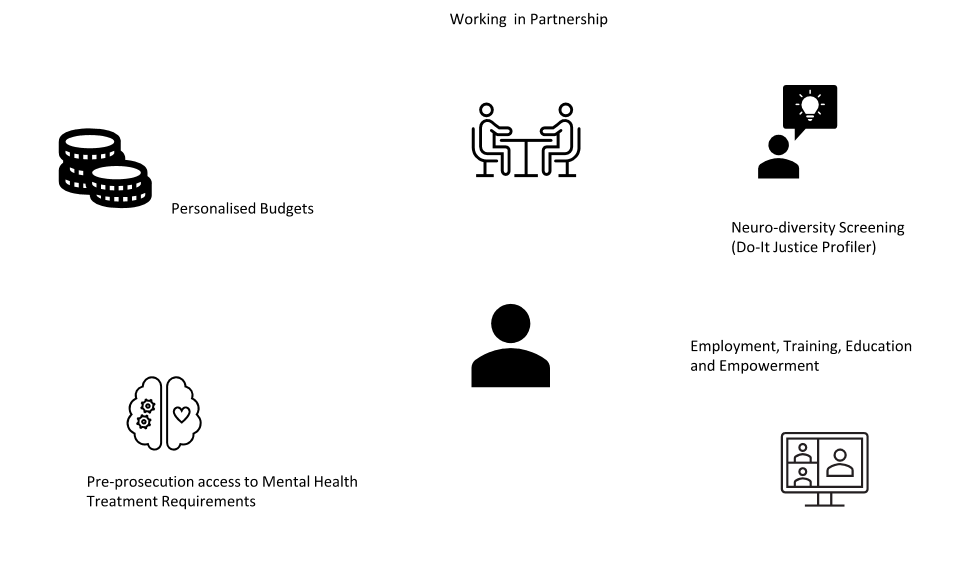
All young adults who enter the scheme have access to the following:
- Neurodiversity screening using the Do-It Justice Profiler tool.
- A personalised budget to engage in employment and education opportunities.
- Pre-prosecution mental health provision.
“Four years on from completing my Pathfinder {now called OOCR} course, I haven’t gotten into any trouble, and I am now working full time in my ideal job and also in a relationship. Life is going well.” (Young Adult)
Key workers carry out a holistic needs and risk assessment to identify the young adult’s strengths and needs.
Devon and Cornwall Police don’t commission services, but they have built relationships with the voluntary sector and local organisations to develop interventions. After a referral has been made to an appropriate organisation, a joint handover meeting is held between the young adult, their key worker, and a representative from the organisation.
The key worker maintains an active relationship with the young adult throughout and is on hand to offer support as needed.
Sarah explains, “This is not about processing people. It’s about building relationships.”
Every young adult enters a four-month contract. All young adults must comply with the following contract requirements:
- No reoffending
- Restorative and reparation conditions
- Rehabilitation programme based on holistic assessment
Engagement with the contract conditions is reviewed based on how the young adult has engaged with the key worker. Sarah reported that there have been few breaches.
Once the contact is completed, the young adult has a meeting with their key worker to review their progress, offer feedback, and agree an exit strategy – ensuring they can continue to develop, grow, and realise their full potential.
Successful completion will result in no further action. If additional support is required, the young adult can stay connected to the service after the four-month period ends.

4 June 2024
Pilot diversion scheme empowering young adults
Desistance from crime, Diversion, Young adults
Julia and Jordan are key workers for the Devon and Cornwall pilot out of court resolution scheme, which has been in operation for the last 18 months. We recently spoke to Julia and Jordan and some of their clients about how this scheme is helping young adults to make positive changes in their lives.
From the outset, Julia and Jordan recognised that young adults require a distinct approach that responds to their entire lived experience. This is crucial as many of their clients have been affected by trauma, abuse, violence and deprivation.
Jordan explains, “Some of the young adults I’ve worked with have had significant adverse childhood experiences. Reading some cases, I’ve thought to myself, ‘How have you only just come to the police’s attention now?’”
Julia adds, “Most of the time, they’ve not really been given the tools to be an adult. There are very few people we see that haven’t been a victim themselves or let down by the system.
“One of the things that we would do more of with this age group is issue regular reminders of appointments. I find that if we see them more often then that momentum of change comes easier. If you don’t see them very often, other things take over and they can disengage from the process.”
Jordan adds, “I always try my best to keep the appointments as concise and practical as possible and not paper based.”
Having dedicated key workers means more attention can be given to each individual. Jordan believes that this allows him to take a much more active role in supporting his clients – even when he’s referring someone to other services.
“You’re not just this referral mechanism. You’re working with each individual to understand what they need.
“For example, I’m working with this young guy called Chris* who’s 21 and was arrested for self-harming in public.
“I asked if he wanted mental health support, which he did, so I made a referral. Within a week, I’ve been able take him over in person to meet his counsellor. Chris is now having up to 12 weekly sessions, which we’re able to access for him through the deferred prosecution scheme. If we hadn’t been able to get that, he’d probably be facing a four-month wait for therapy through the NHS.”
Chris was at a point of crisis, but he has found the therapy sessions hugely beneficial. He says, “I’d tried so many times to get help with my mental health, then it all came to a head. Being able to quickly get support when I needed it the most was really important to me. My counsellor actually listens and remembers things about me. I feel lighter after having a session with her.”
When a good relationship has been established, Julia finds that she can then focus on helping young adults to pursue their aspirations.
“When I started working with Peter*, he was depressed and had withdrawn completely from the community. We did an empowerment activity together, and it came out of this exercise that he had a particular talent and interest in video editing.
“We gave him a variety of tasks to help him develop his skills, including approaching a charity to offer to provide a video they could use to promote their work. For this project, he learned how to work on a storyboard and use video editing software. Peter completed the project and is now on his way to a freelance career in videography.”
Peter adds, “My life is much better, and I haven’t got a sense of guilt anymore. The deferred charge focussed on why I did what I did, why it shouldn’t have happened but also empowered me to move on and focus on my goals.
“I haven’t got a criminal record. I was given an opportunity to use this part of my life to become better, not for it to negatively affect me in the future.”

Jordan and Julia believe that having a personalised budget for each client makes it easier to offer tailored support and interventions.
Jordan explains, “I was working with a young person called Steve* recently who’d had a poor experience of mainstream education and was out of work.
“He was working with a bandofbrothers, which is another good service down here that provide role models and one-to-one mentoring. Steve wanted to get into labouring, and so he needed to do his CSCS (Construction Skills Certification Scheme).
“I spent £13 to get him a train ticket up to the centre to do his initial assessment for a CSCS card. By the time he left the scheme, he had a bricklaying job on a site. That was all down to his strength and motivation and just spending about £13 with the personalised budget. That was enough for Steve to get across that line.”
Steve adds, “I was able to get my CSCS card through the Deferred Charge Scheme, which helped me get a job. It also meant that I didn’t get done for the offences, which would have made getting a job even harder.”
Julia and Jordan both speak effusively about how the scheme has empowered many young adults to shift to a pro-social identity. They share numerous examples of how the young adults they’ve worked with have improved their mental health, pursued careers and life goals, and made reparations to those affected by their actions.
Through the enhanced service, Jordan and Julia can support individuals beyond four months on a voluntary basis. Despite the clear benefits offered, shifting police officers’ perceptions of the scheme has been challenging at times.
“This is not a soft option. Young adults coming on to the scheme have to confront what’s causing them to commit crime and that can be quite tough,” Jordan explains.
Julia adds, “Our clients feel the weight of being under the deferred charge because the circles they’re moving in could lead them to reoffend or to substance misuse. That’s a challenge for them.
“But I let my clients know that it’s not always a straight line and to not disappear if they have a drink, for example. It’s not the fact that you’ve had a blip. It’s about making distance between the blips bigger. That’s progress.”
Ryan* is one of the young adult clients who’s been supported through significant setbacks on a voluntary basis.
Ryan explains, “My life has improved one thousand percent. I was drinking alcohol daily and using crack before the deferred charge. Through the deferred charge I was clean for eight weeks, then was made homeless and went back to it for a week.
“My keyworker didn’t give up on me. They contacted the right agencies and helped me with the food bank. I have been clean for three weeks again now. If I had gone to court there would have been a judge and a solicitor, but no one there after to help me with the addiction that led me to be arrested.
“It would be easy to go back to my old life, but I’m avoiding people and places that would take me back. I have support, and my keyworker for as long as I need her, to get on my feet properly.”
*We have used pseudonyms in this interview to protect each young adult’s identity

Read about research and practice to identify effective approaches for young adults throughout the criminal justice system.
Research and reports 9 April 2024
“Polluted the entire bloodline” – A spotlight on the experiences of young Muslim women in the criminal justice system
Young adults
We spoke to Dr Sofia Buncy, Director and Founder of the Muslim Women in Prison (MWIP) Project, about their latest research project, funded by the Barrow Cadbury Trust, into the experiences of young Muslim women in the criminal justice system.
Since its foundation in 2013, the MWIP has researched the journeys of Muslim women throughout the criminal justice system. Prior to MWIP there had been very little research on this topic.
Sofia and her team are currently focusing on the needs of young Muslim women, aged 18-25. As a minority within a minority, little was known about this group’s needs and outcomes. The initial interviews have revealed some unexpected and worrying findings.
“Two of the young women we spoke to have already said that they were victims of sexual violence within a household. We’ve heard from one Muslim girl who has been involved in gangs and arrested for firearms and involvement in a gang-related death, a crime that we would have never expected.”
Sofia does not suggest that this problem is confined to the Muslim community, but that the ramifications can be more serious for young Muslim women because of the cultural expectations of their families and communities.
“At the recent launch of Agenda Alliance’s A Call To Action paper, a client of MWIP shared her story. She stood up and said, ‘Look I’m a young Muslim girl and I was groomed by a Muslim man. I don’t speak about it because it can have repercussions for my future, for my marriage, for my reputation, and for my standing.’
“I think it really hit everybody hard that day. You could hear a pin drop. We’re getting under the skin of the problems, and it won’t be pretty, but we need to be honest.”
It is rare for young Muslim women to talk openly about their experiences of the criminal justice system because their involvement can be perceived as shameful by family members and the community. They risk abandonment and reprisal for speaking out, so there is little known about what might lead them to involvement with the justice system. The MWIP project hopes to change this, so young Muslim women can access the right support at the right time.
“I don’t think professionals or individuals in the community would have expected the level of exploitation that Muslim girls face, or the changing nature of how they present in the system.”
Sofia believes that one of the factors contributing to criminal justice involvement may be the lack of experience young Muslim women possess around what healthy relationships looks like.
“Some of the young Muslim women we’ve worked with have been wrapped up in cotton wool, in the sense that there’s always a male leader in the family who’s there to protect them. So then how do you know what the red flags are?
“It’s not acceptable for Muslim women to enter premarital relationships, but it would be naive to assume that some of these young girls were not entering relationships in this day and age. Many of them have boyfriends or they’ve gone into relationships, but this is rarely discussed in the community.
“That means there’s no guidance in terms of what healthy looks like. Unfortunately, this means that many girls can assume that their relationship, which may be harmful, is what normal looks like.”
It’s clear that young Muslim women face unique challenges and require a tailored approach, but they face additional barriers to proactively access the support they need.
“There are opportunities for intervention, but young Muslim women are less likely to access support because they often lack agency to make decisions for themselves.”
“In our community, it’s always thought that somebody senior to yourself has your best interests at heart and should make decisions for you. That’s why we have to ask what level of agency do these young Muslim women really have?”
According to Sofia young Muslim women are often held to a higher standard than young Muslim men, and involvement in the criminal justice system can damage their family’s standing in the community.
“Muslim women are deemed as holding the honour of the entire family and the community. Sometimes the ramifications of having committed an offence in the UK are that word will travel back to Somalia or Pakistan or India or Bangladesh. That’s how far reaching it is.
“I’ve had some strong conversations with parents to ask them to forgive their child just as Islam advocates and to let them come back home. But families are worried about how the transference of cultural shame will damage their other daughters’ chances of marriage, so they become estranged. There are some young Muslim women in prison who have no visits at all, not even from their own children.”

Sofia believes that traditional definitions of shame fail to capture the severity of the emotion experienced by young Muslim women.
“I’ll never forget an interview we recently conducted with a young woman, and I was really trying to get to the bottom of her fixation on shame. She said, ‘Sofia, you don’t understand. What I’ve done is polluted the entire bloodline.’ That one sentence fully encapsulated the repercussions of going to prison for young Muslim women. Subsequently, relocation has become a huge issue too.
“Of the women we have spoken to, three have relocated because of issues of shame, dishonour, or potential reprisal. A big part of resettlement is that wrap-around support and these young Muslim women might have no help whatsoever from their family.”
These cultural expectations can also affect the ability of young Muslim women to successfully complete their probation.
“If a young Muslim woman is referred to a women’s centre in Bradford or the town centre probation office, but it’s not near where they live, that presents an immediate problem. They might say to me, ‘I can’t go there. If I go to a different post code, and one of my husband’s friends sees me walking into that place, there’ll be a question mark. What was I doing there?’ We have to understand the reality of many young Muslim women’s lives.
“We’re still finding that some (not all) Muslim women are expected to be the primary caregivers at home. When you’re expected to have breakfast, lunch, and dinner on the table, there’s a level of scrutiny on your day-to-day activities. Professionals might not understand that scrutiny or why, for example, you’re unable to attend a lunchtime probation appointment.”
Until the lived experience of young Muslim women is fully understood by professionals, it will be an uphill battle to improve outcomes.
“I do think there is a quite serious need for training within the probation services to understand these nuances and concepts. Some of it may only come alive when we have women with lived experience speaking, like at the training sessions we run with professionals.
“I have friends who are probation officers, and their caseload is absolutely overwhelming on a day-to-day basis. It takes a lot of time to deal with each case, and even more for specialist cases. But there is expertise out there, such as organisations like ours, so I think it can work if there’s a willingness to share and learn together.”
Sofia hopes that this research project can be a roadmap to a brighter future for young Muslim women.
“We’re asking interviewees what would have stopped them from entering the criminal justice system. Once we’ve accumulated the response, we can start to look at how we prevent young Muslims from becoming involved with the criminal justice system in the first place.”

T2A supports research and practice to identify effective approaches for young adults throughout the criminal justice system
Research and reports 26 March 2024
“There’s a level of ignorance, a not wanting to understand” – Raising Awareness of Acquired Brain Injury (ABI)
Young adults
We spoke to Leo*, a young adult and research assistant who has an ABI, about his experiences of the criminal justice system and how practitioners can adapt their approach to better meet the needs of young adults who have a brain injury.
Leo has a diffuse axonal injury, which is a form of traumatic brain injury. ABI doesn’t always present with obvious indicators, leading to it being sometimes called a ‘hidden disability’. But it can cause significant challenges for young adults in contact with the criminal justice system.
“I had a motorbike accident where my head stopped, but my brain carried on going and shook itself inside my head. I spent two months in a coma. I spent eight months in hospital where I had to learn to walk, talk, eat, drink, and do everything again.
“It affects my speech very minimally but more so when I’m tired. It affects my balance, memory, complex planning, judgement. I have issues with filtering inappropriate comments. When I’m fatigued or when I’m tired from sleep deprivation, they’re all enhanced.
“When I’m very tired, I start speaking slow like I’m drunk. People look at me and, if I don’t know them, they’re like, ‘Have you had a drink?’ I’m like, ‘No, I’ve got a brain injury.’”
When Leo first encountered the criminal justice system in March 2020, he presented the officer with his Headway Brain Injury Identity Card. This identification card is designed to help police officers and staff more easily identify individuals with a brain injury and ensure that they receive an appropriate response and support.
“I pulled my card out. It says if you ever have something to do with the police, call this number. They asked me if I needed food or drink, and they came and checked on me.
There was a delay in interviewing Leo because the police had difficulty securing an Appropriate Adult to accompany him in the interview suite. Leo feels that his interactions with the police were encouraging overall. All the officers he encountered made adjustments to accommodate his needs. However, he recognises that not every young adult will have had an official diagnosis and therefore may not receive the support that the Headway card facilitated.
“People who don’t have that card might not get the right support and adaptations.”
Leo didn’t have any specific challenges navigating courts and sentencing, but his experiences with the probation service demonstrate how much work needs to be done to raise awareness of ABI and its impact on behaviour and cognitive function.
His first probation officer did not have a comprehensive understanding of ABI or how it affected Leo’s ability to easily attend in-person appointments – resulting in two missed sessions early on.
“One of my impairments is complex planning, so travelling on my own somewhere I’ve never been before can be really difficult. When I finally got to meet her, I said that I was so sorry about not being able to come to the past few times. I told her I’ve got a disability, and I know I look well, but this is how it affects me in my day-to-day life. My probation officer said she deemed the absence acceptable due to my disability.”
While it was positive that Leo’s disability was recognised and future appointments were carried out by telephone, he believes that there was a lack of curiosity around his disability and how it fully affected him.
“Without a shadow of a doubt, there’s a level of ignorance to it, a not wanting to understand, and on another level a sense of ‘I’m not sure if I fully believe you’, which was disappointing.”

Around this time, Leo needed an emergency operation. As a result, he was unable to attend a third appointment. Despite offering evidence to his probation officer, his third absence was deemed unacceptable, and he was recalled to court.
“I was found not guilty of the breach. But it was hard to understand how certain missed appointments can be deemed acceptable due to my disability but not at another point because I was having emergency surgery?”
A new probation officer was assigned Leo’s case. Leo attended his first meeting with his father in attendance as his Appropriate Adult.
“We were in the waiting room and the lady came to the top of the stairs. She didn’t even come down the stairs to greet us. She just shouted down and walked off into another room and we followed. She was very standoffish from the get-go.”
Leo started to explain his story to his new probation officer when his father interjected to offer some relevant information.
“He said,’ Hi, I’m Leo’s father and I’m here as his Appropriate Adult.’ Then she stopped him. She said, ‘Sorry, who are you? Why are you here?’ My dad explained, ‘My son has a brain injury, and I’m here as his legal and appropriate adult.’
“She was very antagonistic and said to my dad that you can’t do this, and you can’t be in here. My dad repeated that he needed to be there because I had a disability, and he was my advocate.
“The appointment was scary. It shook us how appallingly unprofessional it was.”
Aside from the probation officer’s shocking lack of professionalism, Leo felt that his disability and the support he required was being questioned by someone who had no knowledge of his case or his ABI.
“I told her that I sometimes struggle to find the words to express what I want to say. She said, ‘Really? I’m talking to you, and you seem like you can express yourself completely fine by yourself.’ It felt like she thought I was lying.
“We complained and ended up getting a formal apology from the CEO of the probation service and the probation officer concerned.”
Thankfully, Leo’s third probation officer was a much more supportive professional who took the time to get to know him and his situation. It was also his first experience of a probation officer who was invested in properly understanding his disability and how it affected him.
Leo believes that all probation officers should be mindful of how they interact with young adults with an ABI and take a more thoughtful and appropriate approach.
“Based on my experience, they need a little bit more empathy and understanding. It’s not empathy over what I’ve done wrong, but empathy and kindness in the situation and how my disability might prevent me from effectively engaging in my rehabilitation, which is the reason I am there.”
Leo has recently been working with the United Kingdom Acquired Brain Injury Forum (UKABIF) on a research project into the prevalence of ABI among young adults in the criminal justice system. He’s also helped to create a flyer to help young adults recognise whether they have an undiagnosed ABI and how to access support.
“I really cared about what was in the flyer, and I was really excited about all the people, like me, that it could help. At the same time, I feel it is also very important that the probation service and other professionals in the criminal justice system see it too. I mean the probation service, by golly, they need to see it. They need to get this information. They need to understand it.”
Moving forward, Leo wants to continue to use his lived experience to ensure that all young adults with an ABI receive the right support at the right time.
“Since my ABI, I have become a father to the most beautiful child, and I’ve got myself back on my feet. Looking ahead, I hope that the work that I am doing with UKABIF on projects like this can continue to help other ABI survivors in the criminal justice system to get their lives back on track.”
*Leo is a pseudonym used to protect the young adult’s identity
Better outcomes for children and young people with an Acquired Brain Injury (ABI)
Read more 26 March 2024
Better outcomes for children and young people with an Acquired Brain Injury (ABI)
Young adultsWe spoke to Stan Gilmour, National Risk Technology Lead in Policing, Strategic Consultant, and Professor of Practice, about how early intervention could prevent children and young people with an Acquired Brain Injury (ABI) from coming into contact with the criminal justice system.
T2A has had a longstanding interest in Stan’s research into ABI, which can impact the process of becoming a fully mature adult1. That’s why it’s crucial to raise awareness of how it presents and impacts people’s behaviours.
The exact number of young adults in the justice system who have an ABI is unknown, but studies suggest that 49-72% of young people in custody have an ABI. Hence we can assume there’s a comparable percentage within the 18- to 25-year-old group.
ABI and criminal justice system
Stan Gilmour has recently started coordinating a project titled “Lost in Translation, Found in Data: Decoding the Neurobiological Undercurrents of Youth Criminalisation” that explores how children and young people with an ABI encounter the criminal justice system. The project is also investigating different approaches to neurodisability worldwide and how those approaches might inform practice here in the UK.
Awareness of ABI among criminal justice agencies has been patchy, but the minimal data available reveals that children and young people with an ABI are being let down by multiple agencies.
“The data tells us that there’s a vicious cycle between adverse childhood experiences, criminal justice contact and brain injury that is largely unaccommodated within statutory systems – not just criminal justice but within social support, healthcare and other wider systems that have prevention as part of their remit.”
An ABI can lead to behaviours that may increase the likelihood of becoming involved in the criminal justice system. Stan explains in more detail:
“Impulsivity and risk-taking behaviours can lead to criminal justice involvement, both of which are key features of ABI.
“When you ask what makes people behave in such a severely non-typical way, one answer is they’re criminals and the other answer is that a condition or disability – such as ABI – is affecting their behaviour.”
Early identification
Stan believes that children and young people with an ABI need to be identified as early as possible to prevent future involvement with the justice system. Ideally, this would take place during early years education, but the likelihood of an assessment at this time is heavily influenced by socio-economic factors.
“You go to school, and if your parents have the resources to make sure you’re identified as having additional needs, then you go on a special educational needs (SEN) programme. If you’re not identified, and that’s much more common in lower-income families, then you go on a behavioural and school mental health (SMH) programme. So lower-income kids are defined as badly behaved, while affluent kids are recognised to have SEN.
“If you have a behavioural diagnosis, you’re badly behaved, you’re a bad kid, and that label can stick with you. This can happen to the extent that your behaviour becomes anti-social and eventually becomes criminal. Therefore, your journey into criminalisation can start at a very early age.”
“With this behaviour comes a good deal of exclusion. Recent research shows that children with brain injuries who are excluded from school are criminalised earlier, and their offending behaviour will be more likely to persist into adulthood. This is one of many examples of how early intervention can deliver better outcomes and save money in the long term.”2
A whole system approach
Stan is a firm advocate of a whole system approach where data is routinely shared between all agencies that are involved in the care of children and young people, including local authorities, healthcare providers, social services, and education.
“We want to identify ways in which the data can be collected more routinely and made available for research and prevention in ways that are more repeatable.
“This would allow a whole system approach to prevention so that interventions can be put in place to stop people from falling out of education. If you’re excluded from school, then often by default you’re forced into inclusion in other organisations, some of them criminal, who may exploit your vulnerability.”
Stan believes that no one agency has the resources to tackle this issue, so data sharing needs to be improved to make early identification possible.
“When we speak to teachers about this, unless they have a personal interest, it’s often the first time they’ve heard about ABI. So how do we ensure teacher training programmes raise awareness of ABI indicators among teachers? And then how do you identify on a local level where teachers can go for support when they recognise those indicators in their pupils?”
“We don’t want teachers to be endlessly searching for that support, so it has to be available locally to meet the need. Of course, capacity building will be required to join those things up, raise awareness, and make it easy to contact providers.”

Effective use of data
Previously, Stan had looked into the feasibility of a digital register that could facilitate better data sharing – ensuring that children and young people receive effective, joined up support.
“I was working on this service directory approach where needs could be entered into a system and support identified locally. These systems exist, but the ones we were developing could also link into the history of the individual and their family to offer suggestions.
“That could be something like, ‘Maybe you should think about this intervention because this is going on in the background and you’ve just not joined the dots.’ It makes it easier to leverage data to prompt people to think wider than just behavioural issues and sanctions, and into needs-based support.
“It is a multi-stakeholder approach. It is a multi-agency approach. There’s no one organisation that has the knowledge or the capacity to deal with these issues on their own.”
According to Stan this approach would require a cultural shift within statutory services, many of which default to working in silos.
“Often you see those organisations working together, but apart, if you will. They’ll come to the table once a month, and they’ll discuss what they’ve been doing since the last meeting. But what they aren’t doing is working together. You wouldn’t necessarily need a meeting if they were working in effective partnerships because they would all be communicating with each other daily. I think the endeavour really is to get more collaborative and work together at the same table.”
Preventing harm before it occurs
The prevalence of ABI among the population is again significantly affected by socioeconomic factors.
“When you’re under the age of five, you’re five times more likely to pick up a brain injury if you’re in the five per cent of the population on the lowest income.”3
Without effective cross-agency relationships, children and young people at risk of brain injury may be identified far too late.
“Generally speaking, you only get to know that they’re at risk of harm when they’ve already been harmed. Is it good enough that your attention is drawn to a child once they’ve been severely assaulted or abused? That’s too late.
“There’s nothing to stop organisations from proactively sharing data to identify risk, other than their own ambition and courage. The Information Commissioner’s Office is very clear that we ought to be sharing information more widely to identify risk before harm occurs.”
To deliver the best outcomes for children and young people with an ABI, we need to know how many people have this disability. This will lead to a better understanding of the role ABI plays in health, wellbeing, and the development of maturity, which in the long run will encourage systems to adapt.
“When we have the data and the greater awareness amongst professionals about how ABI presents, we can start to change systems. That’s when we start to move away from behaviour policies at schools towards inclusion policies that accommodate everyone’s needs. That’s the end goal.”

Neurodiversity, neurodisability and the needs of young adults
Read more- Williams, W.H. (2012) Repairing Shattered Lives: Brain injury and its implications for criminal justice, London, Transition to Adulthood Alliance. ↩︎
- Kent H., Kirby A., Hogarth L., Leckie G., Cornish R. & Williams H., School to prison pipelines: Associations between school exclusion, neurodisability and age of first conviction in male prisoners, Forensic Science International: Mind and Law (2023) ↩︎
- Yates, P. J., Williams, W. H., Harris, A., Round, A. & Jenkins, R. An epidemiological study of head injuries in a UK population attending an emergency department. J. Neurol. Neurosurg. Psychiatry 77, 699 (2006) ↩︎