20 May 2026

On 18 May 2026, the Ministry of Justice published a White Paper on youth justice, outlining reforms to the youth justice system alongside a delivery plan. Titled ‘Cutting Youth Crime, Changing Young Lives,’ the proposals set a clear ambition to prioritise early intervention, rehabilitation, and reduce the number of children in custody. It is positive to see growing recognition of the needs of young adults within this White Paper, however, for this cohort, it stops short of dedicated action. The White Paper states its provisions represent a ‘once-in-a-generation reform of youth justice in England and Wales’, and yet, the provisions do not go nearly far enough in providing a clear vision to reimagine justice for children or young adults.
Whilst the proposals recognise the distinct needs of children, requiring a different approach to adults, we’re disappointed that yet again, the cut-off of services and support at 18 is perpetuated, despite the overwhelming neuroscientific evidence that brain maturation, particularly in areas governing impulse control, risk assessment, and emotional regulation, continues well into the mid-twenties.
A youth justice system that invests in child-centred, developmental approaches and then abandons them the moment a person turns 18 is not evidence-based.
Early intervention and Diversion
T2A’s position is clear: action taken at the point of a custodial sentence is action taken years too late. We welcome focus on prevention, early intervention, and diversion, as key pillars to meaningfully reduce the number of children coming into contact with the criminal justice system. For this reason, the extension of the Turnaround programme is positive, in its support of a voluntary, relational model. However, the scheme must not solely be offered through Youth Offending Teams (YOTs), as it signals a child is already on the cusp of offending or has already offended. To need to get to this point to access support is to act too late. Some of this funding should be diverted to community and grassroots organisations that can engage with families and caregivers well ahead of the point of offending, and prevent, intervene early or divert before they ever get to the attention of the police or YOTs in the first place.
Further, we call on the government to develop an equivalent scheme for young adults at the cusp of the adult criminal justice system, funded through the proposed Youth Justice Innovation Fund. The out-of-court resolution reform consultation should explicitly provide for a young adult framework, including a statutory young adult conditional caution with a mandatory developmental assessment component, and a deferred prosecution scheme for 18 to 25 year olds modelled on successful youth schemes.
Young Futures Hubs, which already extend to age 24 in cases of special educational needs and disabilities, or vulnerabilities, should explicitly include justice-involved young adults in their eligibility criteria, with Youth and Young Adult Justice Service transition workers co-located on site.
Courts and Legal Process
The commitment to review the function of criminal courts for child defendants is welcome, particularly the consideration of whether young adults might benefit from a similar process. T2A asks that this review explicitly includes young adults aged 18 to 25 in its terms of reference, drawing on international evidence of young adult courts, and considers piloting a young adult intervention court pathway running alongside the proposed Youth Intervention Courts.
We also ask that the mandatory specialist training proposed for lawyers representing children is extended to cover defendants aged 18 to 25, with training materials focused on neurodevelopmental evidence and young adult vulnerability.
Sentencing
Whilst T2A strongly supports the move away from short custodial sentences and the strengthening of community alternatives for children, we know that sentences for young adults are getting longer and longer. The data may show decreasing numbers of young adults coming through the system, but for those who are still impacted, the process is getting tougher.1 T2A have long called for the establishment of young adults as a distinct statutory cohort within the criminal justice system through an ‘Emerging Adult Transition Status’, with specific sentencing protections, similar to that of children.
We ask that sentencing guidelines are amended to require courts to consider neurodevelopmental maturity, not age alone, as a mitigating factor for all defendants under 25, and that statutory maturity assessments are available at sentencing for this age group. We also ask that the presumption against short custodial sentences being developed for the youth estate is extended to the 18 to 25 cohort.
Remand
We know that many children and young adults who are remanded to prison are eventually either acquitted or given a community sentence. In 2024, 441 children who were in custody awaiting a hearing did not end up receiving a custodial sentence, and another 168 children had their case dismissed altogether.2 For those who have been languishing in prison for months, even years, this is not justice.
The 25 per cent reduction target for unnecessary custodial remands is therefore welcome, and we urge its extension to young adults. Although fewer young adults are going through the courts, those that do find themselves in court for more serious offences are increasingly more likely to be remanded in custody and to receive custodial sentences, and less likely to receive community sentences.3
T2A calls for the community remand alternatives funded under this programme to be made available on a step-up basis for 18 to 25 year olds entering the adult system, and that a statutory transition planning meeting is required for any young person who turns 18 while on remand.
Crucially, reviewing racial disproportionality within remand decisions must include 18 to 25 year olds.
We know remand disproportionately impacts Black and racially minoritised children and young adults: in June 2023, 26 per cent of remanded 18-20-year-olds and 18 per cent of remanded 21–25-year-olds were Black, compared to less than six per cent and five per cent respectively in the general population.4 It’s critical to consider Gypsy, Roma and Traveller young adults within scope of this too. Gypsy, Roma and Traveller young adults are disproportionately remanded to custody, and face some of the worst disparities and outcomes within the criminal justice system, although hesitancy to disclose ethnicity due to discrimination results in a significant undercount on official records.5
Further, specific attention must be given to the disproportionate impact of remand on girls and young adult women. In March 2025, over half of the young women (aged 18-20) in prison were there on remand.6 This coincides with worryingly high levels of self-harm amongst young women in prison, the overwhelming majority of whom have committed non-violent offences. We call on the Ministry of Justice to therefore expand specific consideration to young adult women.
Custody and Transition
As the youth custodial population becomes smaller and more focused on serious offences, increasing numbers of children will serve sentences extending well into adulthood. We are glad to see the White Paper acknowledge the transition from youth to adult custody as a problematic point, as was found in our lived experience focus groups for our response to the Justice Committee’s inquiry into Children and Young Adults – but we see no plan of action attached to this. Our ask is that the Youth Custody Transformation Plan include a dedicated chapter on transition to the adult estate, with statutory joint planning between youth custody and the adult prison service from at least three to six months prior to transfer.
Further, in line with our recommendation made to the Justice Committee, T2A asks the Ministry of Justice to pilot a young adult wing model in the adult estate adjacent to youth custodial sites. It is necessary for this wing to be carefully co-designed with young adults themselves, for young adults to have access to older peers – who, according to lived experience focus groups – can provide a calming influence on the wing – and a dedicated trauma and culturally responsive, developmentally appropriate regime, with continuity of staff and therapeutic relationships, alongside meaningful access to education, employment and entrepreneurial opportunities.
Annmarie Lewis OBE, Head of Criminal Justice at Barrow Cadbury Trust:
“The central ask of T2A is clear: the developmental, rehabilitative principles underpinning this White Paper should not stop at age 18. We must consider children and young adults together, because their experiences are fundamentally connected. We cannot understand young adults in the justice system without examining the pathways that led them there, just as we cannot speak about children without recognising where those pathways so often end. This is not two separate challenges, but a single journey – a shared pipeline. Every cliff edge at 18, every point at which we withdraw developmentally informed support, reflects a conscious policy choice with real and measurable human consequences.
We urge the government to commission a companion Young Adult Justice Strategy that cuts across prisons, courts, probation, policing and prevention services, and to ensure that every reform set out here – in courts, sentencing, remand, records, diversion and custody – is explicitly considered for application to young adults.
But we need to go further. To keep focusing on solutions at the latter end of the system – where the most harm is concentrated – to the detriment of investment into schools, local communities, tackling poverty, and youth and community provision, is to let both children and young adults down. What we need is a fundamental reimagining of justice, and that must coincide with a diversion of funds from the custodial estate into investment into the voluntary and community sector, alongside a cross-departmental effort to improve the lives of every child and young adult.”
- Centre for Crime and Justice Studies (2026) Smaller But Tougher ↩︎
- Childrens Commissioner (2025) “A production line of pointlessness”: Children on custodial remand ↩︎
- Centre for Crime and Justice Studies (2025) Smaller, but tougher: How the criminal justice system is processing young adults ↩︎
- Howard League (2023) What’s wrong with remanding young adults to prison: voices and lessons learned ↩︎
- Friends, Families, Travellers (2025) Trapped in the Turnstile: Gypsy, Roma and Traveller people’s experience of the criminal justice system ↩︎
- Centre for Crime and Justice Studies (2025) Smaller, but tougher: How the criminal justice system is processing young adults ↩︎
27 February 2026
T2A’s take: A new model for policing
Diversion, Policing and arrest, Young adults
On 27 January 2026, a White Paper ‘From local to national: a new model for policing’ was published, setting out a series of sweeping reforms to policing. In proposals described by the Home Secretary, the Rt Hon Shabana Mahmood MP as ‘the most significant modernisation in nearly 200 years’, several changes could serve to significantly alter the oversight, governance, and day to day function of policing in England and Wales.
Key changes
- The creation of the National Police Service (NPS), incorporating agencies including the National Police Chiefs’ Council, the College of Policing, the National Crime Agency and Counter Terrorism Policing into a single organisation to focus on serious and organised crime, and threats to national security. This proposal seeks to ‘lift the burden of delivering national responsibilities from local forces, ensuring that their focus is entirely on policing their streets.’
- A substantial reduction in the number of local forces, possibly by altering force boundaries and merging existing forces into fewer, larger forces. There are currently approximately 43 local police force areas across England and Wales. The White Paper states that an independent review will be undertaken into force structures, resulting in a significant reduction to the number of forces by the end of the next Parliament.
- The abolition of Police and Crime Commissioners (PCCs) by 2028, to be replaced by Strategic Authority Mayors and local council leaders through Policing and Crime Boards. Over time, these Boards will be adapted to provide the governance of future fewer, larger police forces.
- Creation of Police.AI, a new centre for the utilisation of Artificial Intelligence (AI) powered tools and software within policing to automate manual processes.
What does the White Paper say about young adults?
The White Paper proposes to continue investment into the Young Futures Programme through Young Futures Hubs and Prevention Partnerships, to reduce the involvement of young people in crime. Highlighting the importance of early intervention, the proposals reference Violence Reduction Units and the County Lines Programme as interventions that prevent young people from being drawn into crime and reduce knife crime.
What is the Young Futures Programme?
The Young Futures Programme is a government-led programme consisting of Young Futures Prevention Partnerships and Young Futures Hubs, described in the National Youth Strategy as a ‘new approach to tackle knife crime and violence.’
Young Futures Prevention Partnerships ‘identify young people vulnerable to being drawn into crime at local authority level and provide them with support at the right time’, through multi-disciplinary panels run in Violence Reduction Unit (VRU) areas. These Panels will aim to prevent crime and engage in early intervention by identifying and referring young people at risk of crime to a range of different support services, including the Young Futures Hubs.
Young Futures Hubs aim to bring together services to improve access to opportunities and support for young people at community level. In July 2025, the Prime Minister set out plans to open 50 hubs over the next four years. £2 million has been made available to eight local authorities this financial year to design and implement ‘early adopter’ Young Futures Hubs, in: Nottingham, Tower Hamlets, County Durham, Manchester, Birmingham, Brighton and Hove, Bristol, and Leeds.
Our view
Despite welcome language around prevention, our concern remains that an over-investment in policing to the detriment of well-funded, community-based children and young adult provision continues to entrench feelings amongst young adults of being overpoliced and disinvested in. Instead, the police should support diversions from the justice system for young adults, and maximise opportunities to move away from crime and develop positive identities as they navigate the transition to adulthood.
The ‘bobbies on the beat’ community policing angle, referenced within the White Paper with the commitment to deliver 13,000 additional neighbourhood policing personnel in police forces across England and Wales, comes from a place of viewing increased police presence as a safety measure, ignoring the reality that many young adults – particularly marginalised and overpoliced communities including racially minoritised people, girls and young women, those with care experience and people from socioeconomically deprived communities – feel less safe, and even victimised by the police. Work to divert young adults away from the criminal justice system cannot be relegated to a specific programme or pilot, but rather requires a whole-systems approach and a rethinking of police contact and response tactics. T2A advocates for the police to receive specific training for managing contact with young adults, particularly on stop and search and when making arrests, and that innovative diversion programmes delivered by grassroots, community-based organisations are commissioned and sustainably funded by the Strategic Authority Mayors and Policing and Crime Boards that will come to replace PCCs.
The increasing reliance on AI within policing is a cause for serious concern. We already know the racialised nature of facial recognition tools, and the impact this has had on community relationships and trust and confidence in the police, particularly amongst young adults. In a recent visioning workshop with T2A alliance members, supporters, and partners, participants were fearful of algorithmic bias in tools used for risk assessment, sentencing recommendations, and predictive policing, noting that these systems often rely on historical data that reflect existing inequalities, such as over-policing in certain communities. Only recently, a man of South Asian heritage was arrested in Southampton on suspicion of burglary as a result of a facial recognition error, despite being 100 miles away from the scene in Milton Keynes, and the suspect looking ten years younger. Without careful design and oversight, AI tools can reinforce and perpetuate racial biases. T2A workshop participants called for pre-emptive reform to prevent embedding discrimination into automated decision-making.
Looking forward
Our vision is to create a blueprint for a justice system that sees young adults not as problems to be solved or issues to be fixed, but as people shaped by their experiences with incredible capacities to progress, grow, and change. Policing structures, responses and adjoining programmes need to reflect this sentiment, and reform not only their geographic boundaries and use of technology, but approach to young adults from a perspective of compassion and guidance, rather than criminalisation and surveillance. T2A is concerned that reform that is not co-produced with communities will have little positive impact, and hope that the implementation of these proposals includes close consultation with young adults with experience of police contact and the organisations that work with and support them.
4 June 2024
Pilot diversion scheme empowering young adults
Desistance from crime, Diversion, Young adults
Julia and Jordan are key workers for the Devon and Cornwall pilot out of court resolution scheme, which has been in operation for the last 18 months. We recently spoke to Julia and Jordan and some of their clients about how this scheme is helping young adults to make positive changes in their lives.
From the outset, Julia and Jordan recognised that young adults require a distinct approach that responds to their entire lived experience. This is crucial as many of their clients have been affected by trauma, abuse, violence and deprivation.
Jordan explains, “Some of the young adults I’ve worked with have had significant adverse childhood experiences. Reading some cases, I’ve thought to myself, ‘How have you only just come to the police’s attention now?’”
Julia adds, “Most of the time, they’ve not really been given the tools to be an adult. There are very few people we see that haven’t been a victim themselves or let down by the system.
“One of the things that we would do more of with this age group is issue regular reminders of appointments. I find that if we see them more often then that momentum of change comes easier. If you don’t see them very often, other things take over and they can disengage from the process.”
Jordan adds, “I always try my best to keep the appointments as concise and practical as possible and not paper based.”
Having dedicated key workers means more attention can be given to each individual. Jordan believes that this allows him to take a much more active role in supporting his clients – even when he’s referring someone to other services.
“You’re not just this referral mechanism. You’re working with each individual to understand what they need.
“For example, I’m working with this young guy called Chris* who’s 21 and was arrested for self-harming in public.
“I asked if he wanted mental health support, which he did, so I made a referral. Within a week, I’ve been able take him over in person to meet his counsellor. Chris is now having up to 12 weekly sessions, which we’re able to access for him through the deferred prosecution scheme. If we hadn’t been able to get that, he’d probably be facing a four-month wait for therapy through the NHS.”
Chris was at a point of crisis, but he has found the therapy sessions hugely beneficial. He says, “I’d tried so many times to get help with my mental health, then it all came to a head. Being able to quickly get support when I needed it the most was really important to me. My counsellor actually listens and remembers things about me. I feel lighter after having a session with her.”
When a good relationship has been established, Julia finds that she can then focus on helping young adults to pursue their aspirations.
“When I started working with Peter*, he was depressed and had withdrawn completely from the community. We did an empowerment activity together, and it came out of this exercise that he had a particular talent and interest in video editing.
“We gave him a variety of tasks to help him develop his skills, including approaching a charity to offer to provide a video they could use to promote their work. For this project, he learned how to work on a storyboard and use video editing software. Peter completed the project and is now on his way to a freelance career in videography.”
Peter adds, “My life is much better, and I haven’t got a sense of guilt anymore. The deferred charge focussed on why I did what I did, why it shouldn’t have happened but also empowered me to move on and focus on my goals.
“I haven’t got a criminal record. I was given an opportunity to use this part of my life to become better, not for it to negatively affect me in the future.”

Jordan and Julia believe that having a personalised budget for each client makes it easier to offer tailored support and interventions.
Jordan explains, “I was working with a young person called Steve* recently who’d had a poor experience of mainstream education and was out of work.
“He was working with a bandofbrothers, which is another good service down here that provide role models and one-to-one mentoring. Steve wanted to get into labouring, and so he needed to do his CSCS (Construction Skills Certification Scheme).
“I spent £13 to get him a train ticket up to the centre to do his initial assessment for a CSCS card. By the time he left the scheme, he had a bricklaying job on a site. That was all down to his strength and motivation and just spending about £13 with the personalised budget. That was enough for Steve to get across that line.”
Steve adds, “I was able to get my CSCS card through the Deferred Charge Scheme, which helped me get a job. It also meant that I didn’t get done for the offences, which would have made getting a job even harder.”
Julia and Jordan both speak effusively about how the scheme has empowered many young adults to shift to a pro-social identity. They share numerous examples of how the young adults they’ve worked with have improved their mental health, pursued careers and life goals, and made reparations to those affected by their actions.
Through the enhanced service, Jordan and Julia can support individuals beyond four months on a voluntary basis. Despite the clear benefits offered, shifting police officers’ perceptions of the scheme has been challenging at times.
“This is not a soft option. Young adults coming on to the scheme have to confront what’s causing them to commit crime and that can be quite tough,” Jordan explains.
Julia adds, “Our clients feel the weight of being under the deferred charge because the circles they’re moving in could lead them to reoffend or to substance misuse. That’s a challenge for them.
“But I let my clients know that it’s not always a straight line and to not disappear if they have a drink, for example. It’s not the fact that you’ve had a blip. It’s about making distance between the blips bigger. That’s progress.”
Ryan* is one of the young adult clients who’s been supported through significant setbacks on a voluntary basis.
Ryan explains, “My life has improved one thousand percent. I was drinking alcohol daily and using crack before the deferred charge. Through the deferred charge I was clean for eight weeks, then was made homeless and went back to it for a week.
“My keyworker didn’t give up on me. They contacted the right agencies and helped me with the food bank. I have been clean for three weeks again now. If I had gone to court there would have been a judge and a solicitor, but no one there after to help me with the addiction that led me to be arrested.
“It would be easy to go back to my old life, but I’m avoiding people and places that would take me back. I have support, and my keyworker for as long as I need her, to get on my feet properly.”
*We have used pseudonyms in this interview to protect each young adult’s identity

Read about research and practice to identify effective approaches for young adults throughout the criminal justice system.
Research and reports 4 June 2024
Devon and Cornwall Police – An Evidence-Based Approach to Diversion
Desistance from crime, Diversion, Young adults
In March, we held our T2A (Transition to Adulthood) Alliance meeting – a quarterly gathering of organisations working towards improving outcomes for young adults. One of our guest speakers was Sarah Carlsen-Browne, Senior Manager for Reducing Reoffending at Devon and Cornwall Police, who spoke about their enhanced service for 18-25 years olds and those with care experience.
Sarah Carlsen-Browne began by speaking to the assembled Alliance members about how crucial it is for the public to have a positive perception of diversion schemes.
That’s why, Sarah says, it’s crucial to focus on the facts. Research shows that adults released from custodial sentences of less than 12 months have a reoffending rate of 57.5%1.
Sarah adds: “We know formal processing is less effective for low level offending, and the evidence for diversion is much more compelling. But culture change is vital to shift negative perceptions.”
Sarah argues that a more nuanced approach is required – one that recognises that young adults who commit low-level offences have often been failed by the system on multiple occasions. To reinforce this point, Sarah pointed to a finding in The Lammy Review:
“Many prisoners arrive in custody as damaged individuals. In the youth estate, 33% arrive with mental health problems, whilst a similar proportion presents with learning difficulties. A third of children in prison have spent time in the care system, 45% arrive with substance misuse problems and 61% have a track record of disengagement with education.2”
This was one of several factors that prompted Devon and Cornwall Police to develop a new Out of Court Resolution (OOCR) scheme to reduce reoffending amongst 18-25-years olds and care leavers.
The scheme takes a strength-based approach to working with young adults – helping them to take positive steps towards a pro-social identity. It also helps individuals to be mindful of the harm they may have caused and the consequences of their behaviour.
Sarah describes the attitude adopted by professionals as:
“We’ll be open-minded, curious and aspirational about individuals coming to police attention and think creatively about how we can prevent future harm and demand.”
The day-to-day operations are handled by two key workers who are trained in how to sensitively respond to young adults’ needs. For example, they can meet young adults away from official places like police stations.
“We always ensure that we recruit the right individuals for these roles, and they are trained in everything they need to know to work successfully with young adults once in post.”
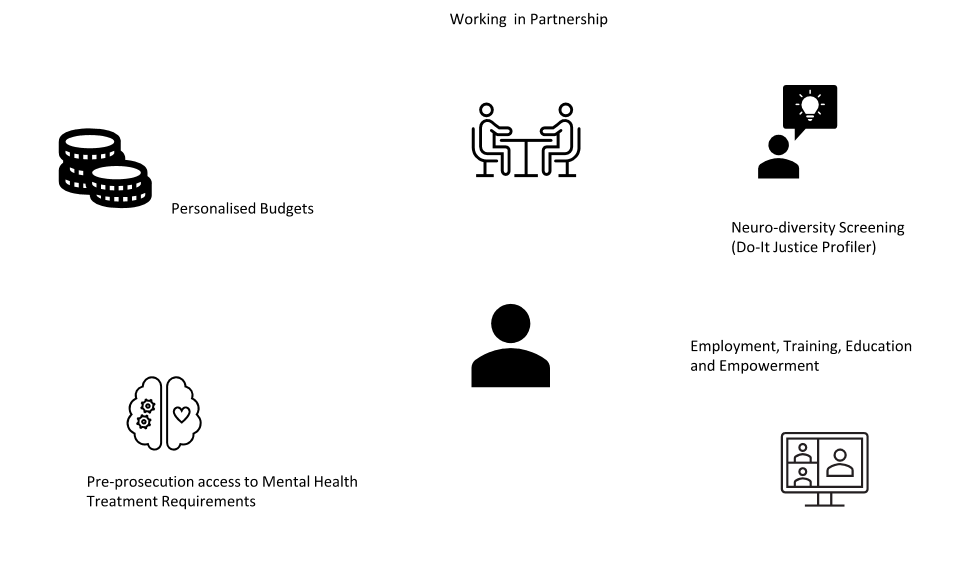
All young adults who enter the scheme have access to the following:
- Neurodiversity screening using the Do-It Justice Profiler tool.
- A personalised budget to engage in employment and education opportunities.
- Pre-prosecution mental health provision.
“Four years on from completing my Pathfinder {now called OOCR} course, I haven’t gotten into any trouble, and I am now working full time in my ideal job and also in a relationship. Life is going well.” (Young Adult)
Key workers carry out a holistic needs and risk assessment to identify the young adult’s strengths and needs.
Devon and Cornwall Police don’t commission services, but they have built relationships with the voluntary sector and local organisations to develop interventions. After a referral has been made to an appropriate organisation, a joint handover meeting is held between the young adult, their key worker, and a representative from the organisation.
The key worker maintains an active relationship with the young adult throughout and is on hand to offer support as needed.
Sarah explains, “This is not about processing people. It’s about building relationships.”
Every young adult enters a four-month contract. All young adults must comply with the following contract requirements:
- No reoffending
- Restorative and reparation conditions
- Rehabilitation programme based on holistic assessment
Engagement with the contract conditions is reviewed based on how the young adult has engaged with the key worker. Sarah reported that there have been few breaches.
Once the contact is completed, the young adult has a meeting with their key worker to review their progress, offer feedback, and agree an exit strategy – ensuring they can continue to develop, grow, and realise their full potential.
Successful completion will result in no further action. If additional support is required, the young adult can stay connected to the service after the four-month period ends.