20 January 2021
T2A (Transition to Adulthood) welcomes the publication of this important short thematic report on Outcomes for Young Adults in Custody which makes it clear that there is a lack of a clear strategy for young adults in custody, resulting in lost opportunities and poor outcomes. Although some individuals working in the prison system are highly motivated, their efforts are hampered by the lack of a systematic approach, integrated strategy and limited resources for this age group.
The Chief Inspector’s report endorses many of the key findings and recommendations of a decade of T2A research and other independent reviews of how this age group are dealt with in prisons. We have long-advocated for distinct prison estate accommodation for this age group — separate from the over 25s — including well-tailored, developmentally-appropriate regimes that addresses the distinct needs – and opportunities for change – presented by young adults. Outcomes for young adults have been poor for a considerable time and will be exacerbated by the current pandemic. T2A has been particularly concerned about outcomes for people of colour, people identifying as gypsy, traveller and Roma, and care experienced young people in and following custody. A more effective approach would understand the experiences of these people as well as young adults more generally and build on the numerous examples of effective practice undertaken in other jurisdictions in the UK and internationally.
The Government can do more to stop these young people from becoming lifelong criminals who undermine our public safety. It is imperative that this evidence and the volume of credible voices calling for change are reflected in the Sentencing Bill when it comes before Parliament, otherwise an ‘open goal’ opportunity to reduce reoffending and be smarter about how we treat this group will be missed.
Joyce Moseley, Chair of T2A said: “It is frustrating that despite practitioner, academic, government and Inspectorate findings, we have seen so little progress for young adults at a time when the criminal justice system so needs an evidence-based strategy to mitigate the impact of the pandemic. If the Government fails to act on yet one more damning report it will be another indictment of its failure to respond to the needs of a lost generation of young people, locking them into a cycle of crime and undermining public safety.
24 June 2020
Hundreds of children facing endless delays in the criminal justice system are being convicted as adults
Young adultsA new report by the Youth Justice Legal Centre (YJLC), part of Just for Kids Law, reveals that severe delays in the criminal justice system are leaving children, families and victims in limbo, resulting in serious consequences for those who turn 18.
System delay is the main explanation for why children turn 18 years old between the commission of an offence and prosecution. COVID-19 has exacerbated delays throughout the criminal justice system which is having a significant impact on children approaching their 18th birthday.
The most recent official data shows that 1,400 offences a year are committed by children who turn 18 prior to conviction but it is believed this is a significant underestimate and the number is expected to rise. Turning 18 prior to prosecution means the young people have their cases heard in adult courts and lose the opportunity to benefit from the youth justice system. This often happens because it can take months or sometimes years for the police or the Crown Prosecution Service (CPS) to make a charging decision. There are currently no fast-track options for children, including those approaching their 18th birthday.
The outcomes for children who turn 18 are vastly different to those of their peers who are prosecuted as children. The damaging consequences include losing access to youth diversion schemes, losing anonymity during court proceedings, only being eligible for adult sentences including much longer rehabilitation periods which reduce employment prospects and prevent people from moving on with their lives.
Just for Kids Law is calling for timely justice for those who commit offences as children. The report, Timely Justice: Turning 18, recommends that where this is not possible the same sentencing framework should be applied to all those who offend in childhood. It also recommends a time limit of three months during which a child can be subject to release under investigation. And the report identifies an urgent need to collect and regularly publish accurate data on children who are released under investigation and those who commit offences but turn 18 prior to conviction.
The Youth Justice Legal Centre has also developed a legal guide to help lawyers navigate the different rules, regimes and principles which apply to those turning 18 in the criminal justice system.
Enver Solomon, Chief Executive at Just for Kids Law, said:
‘It is a travesty of justice that due to unnecessary delays in the criminal justice system young people who have offended in childhood are not able to benefit from legal protections which exist for those who break the law as children. As a result of the pandemic and court closures the situation is much worse with yet more delays and even more children being convicted as adults. Timely justice is crucial for children, families and victims. Young adults who committed offences as children must be given the opportunity to build meaningful futures and be treated fairly.’
22 April 2020
Preventing young adults being caught in the ‘revolving door’
Young adults
New data obtained by Revolving Doors Agency under the Freedom of Information legislation reveals that:
- Over half of all reoffences committed by young adults are theft and summary non-motoring offences.
- Young adults whose index offences are theft and summary non-motoring offences also have the highest rates of reoffending in the same category as their index offence.
- Theft creates the highest level of churn of repeat offences in the same category, with a ratio of 994 reoffences per 1,000 reoffenders.
- This rate is strikingly above any other crime category. It is 12 times higher than repeated possession of a weapon (for example carrying knives) and 6 times higher than repeated violence against a person.
These new figures expose the difference in demand created by young adults committing more serious and sometimes violent crime and the group often called ‘the revolving door’ who commit persistent low-level offences driven by a combination of needs stemming from complex trauma and poverty. These repeated, non-violent offences drive demand for our police, courts and justice system but are driven by underlying, unaddressed need.
The volume and churn of young adults who are sucked into the criminal justice system for relatively minor offences highlights the need for a radical new approach. The current failing approach resulted in the proportion of people with a history of repeat offending reaching at its highest ever level, accounting for nearly two fifths of all offenders.
This stark evidence comes at the same time as Revolving Doors publish an evidence briefing “New Generation” highlighting the critical role of Police and Crime Commissioners and police services in preventing the new generation of young adults entering the revolving door. The report brings together new perspectives on characteristics and needs of young adults entering the revolving door.
Revolving Doors Agency has also announced that they are offering bespoke consultancy and intensive on the ground support for five areas to kick-start local initiatives. These sites will benefit from their research, lived experience, policy, and service design expertise. Their support, which will be free of charge, can help Police and Crime Commissioners and their offices implement new strategies to support better options for young adults, such as deferred prosecutions or diversion schemes to keep young adults out of the criminal justice system.
29 January 2020
Nacro publishes toolkit for working with children in the criminal justice system
Young adults
Nacro has published Using an identity lens: Constructive working with children in the criminal justice system.
Research has shown that identity, and how you feel about yourself, can be key to moving forward with life and away from crime. Working with the University of Salford, Youth Offending Teams and supported by the Barrow Cadbury Trust, this toolkit has been developed to promote a constructive, identity-focused approach to ultimately help divert children away from progressing further through the criminal justice system. Using the principles of the Nacro-led Beyond Youth Custody programme, this toolkit outlines how these can be applied to working with children before custody to support them towards positive outcomes and prevent further offending. It includes sections on:
Understanding the importance of identity
Helping children develop their pro-social identity
Tools to help you work constructively
Whilst this toolkit has been aimed primarily at practitioners working with children in Youth Offending Teams, it could be applied when working with young adults and young people in different settings. The aim is to provide an approach which can be embedded over time and shape current practices, encouraging practitioners to think about how they can use an identity lens to better promote positive outcomes which, in turn, prevents offending.
For more information about this toolkit contact: Caroline.Drummond@nacro.org.uk.
20 September 2018
Formal sentencing principles for young adults would help judges and magistrates says Howard League report
Young adults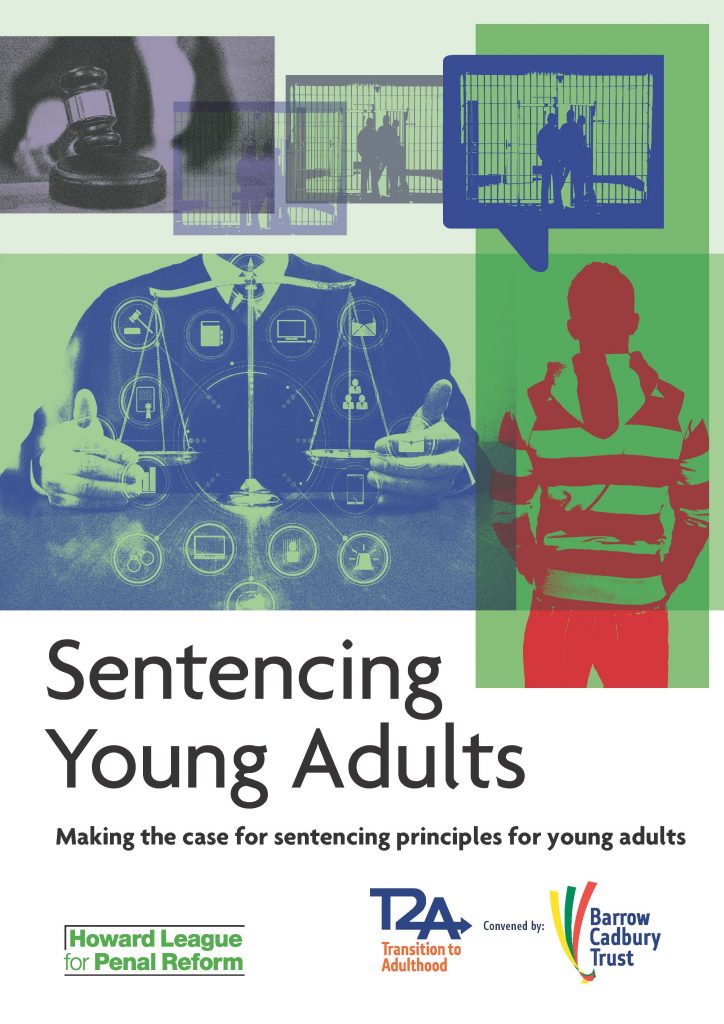
Formal sentencing principles for young adults aged 18 to 25, similar to the Sentencing Council guidelines that are in place for children, would assist the courts and improve sentencing outcomes, a new report recommends.
Sentencing Young Adults: Making the case for sentencing principles for young adults presents research by the Howard League for Penal Reform, a founding member of the Transition to Adulthood (T2A) Alliance.
The report, which draws on Howard League participation work with young adults, sets out how principled guidelines would help judges and magistrates to understand young adults better, and provide a legal framework to achieve better sentencing decisions. It recommends that the principles should consider the relationship between immaturity and blameworthiness, capacity to change, and the impact of race and histories of care.
It considers how the welfare principle – the principle that, when a court is dealing with proceedings relating to a child, its primary consideration shall lie with the welfare of the child – might be extended to apply to young adults, in recognition that full maturity and all the attributes of adulthood are not magically conferred on young people on their eighteenth birthdays.
The Howard League has brought together an advisory group of experts to help draft sentencing principles for young adults, drawing on the charity’s legal and participation work and the growing knowledge base about the needs and characteristics of young people.
More than 140,000 young adults aged 18 to 24 were sentenced in criminal courts last year.
Imprisonment of young adults can have tragic consequences. Between 2006 and 2016, 164 young adults aged 18 to 24 died in custody, 136 of whom lost their lives through suicide.
8 September 2017
T2A response to Lammy Review
Young adults
T2A welcomes the findings and recommendations of the Lammy Review published today.
Whilst the number of young adults in the prison population has decreased, the proportion of BAME young adults has risen. T2A is very concerned by this growing disproportionality of BAME young adults in the criminal justice system and in particular the prison population. It is also vital that the ‘double disadvantage’ faced by BAME women in the CJS is recognised and addressed. The government’s response to this Review will be crucial in addressing these longstanding disparities.
The Review is right to identify the specific needs of young adults, and its recommendations for policy and practice reform would go some of the way towards T2A’s aim of promoting and disseminating the evidence for a distinct approach to the 18-25 young adult population involved in the CJS.
In particular, T2A supports the proposal that every young adults’ maturity should be taken into account in criminal justice decision-making. This reflects evidence from neuroscience that shows young adults’ brains are not fully developed until the mid-20s.
T2A also welcomes the recommendation that professionals have the option of “extending the support structures of the youth justice system for offenders over the age of 18 who are judged to have low levels of maturity”. This is a common-sense approach that has been tried and tested in most European countries, where youth justice routinely extends beyond 18, and in some cases well into the late 20s.
T2A and its partners await the official response to the Review with interest, and will seek to support its implementation
16 May 2016
Making a difference to young adults’ lives – interim evaluation report of T2A Pathway Programme published
Young adultsSheffield Hallam’s first interim evaluation report into the Transition to Adulthood Pathway Programme, in partnership with Social Justice Solutions (SJS), has been published today.
The University and SJS were commissioned by Barrow Cadbury Trust to evaluate the T2A Pathway programme demonstration projects which were set up to test approaches which take account of maturity and transitions for young adults at key points on the T2A Pathway.
The six projects are run by voluntary organisations which provide targeted initiatives to support young people and address the underlying causes of crime. The organisations are Addaction, Advance, PACT, The Prince’s Trust, Remedi, and Together for Mental Wellbeing.
This evaluation report drew on the lessons learned from the T2A pilot projects (2009-2013) and will provide an evidence base for the T2A approach with examples of best practice and case studies. It also outlines what could be done differently at each stage of the criminal justice process – from policing and arrest to custody and resettlement – and provides robust evidence and recommendations for commissioners, practitioners and policy-makers.
This is the first interim report for the evaluation. A further interim report, final formative evaluation report and final summative evaluation report are due to be produced later this year and in 2017. The report presents research findings focused on the development, set up and early implementation of the T2A Pathway projects, examining the effectiveness of the processes and partnership arrangements used to deliver the approach within each project site.
Panda Media have also been filming the projects to capture the effectiveness of the projects, to demonstrate how T2A principles are embodied in a ‘real life’ environment and to give a voice to some of the young adults and staff involved. You can see the videos here.
While the six projects operated at different points on the T2A Pathway their delivery models had common features such as: a welfare-driven approach to young adults; a befriending relationship between project staff and clients; and a holistic approach to the complex and numerous needs of clients.
Some projects benefited from their past experience of delivering similar services, and others from existing working relationships with key statutory partners, such as police, probation and YOTS. Some projects were able to align their service to meet a locally-identified unmet need that had been identified by key statutory agencies.
Whilst a proportion of the projects appeared to be on track to achieve the target numbers of clients that had been originally identified in applications, challenges remained for others in securing referrals to meet their targets; in some instances this was due to a mismatch between available resources and the scope of the delivery model, which may have been too ambitious.
The interim report found that deploying staff with the right attitude and skills to work with the client group combined with effective staff induction and appropriate training made a big difference to the capacity of a project to operate effectively.
Partnership working operated at different levels across the projects. Projects with the involvement of senior managers from statutory agencies and those with project staff visibly working in partner agency environments saw benefits. However, the report found that cultural dissonance between VCS and statutory agency staff was evident in some projects.
Many of the factors which can improve a project and many of the barriers to the successful development, set-up and operation of projects are not new and are common to these types of initiatives. A body of evidence already exists to provide learning about these issues.
Project beneficiaries, project staff and partner agencies were able to identify common benefits such as enhancing self-esteem, encouraging a more positive outlook on their lives, and learning life skills. Benefits for the VCS lead organisation included: an appreciation of the benefits of delivering a preventative initiative; better working relationships with statutory agencies; and expanding their network of agencies. Project and partner agency staff also became more aware of the importance of staff understanding the needs of young adults and females specifically and how that understanding could reduce demand on services as well as reducing workloads.
26 April 2016
T2A gives evidence to the Justice Select Committee Inquiry on Young Adult Offenders
Young adultsT2A has today provided oral evidence to the final session of the Justice Select Committee’s Inquiry on Young Adult Offenders.
The Committee, whose landmark Inquiry has lasted seven months and will likely report in the next few weeks, heard from a panel including Max Rutherford, Criminal Justice Programme Manager at the Barrow Cadbury Trust. He gave evidence on behalf of T2A, alongside Professor Huw Williams (who has led a number of T2A projects on neuro-maturation and crime) and Angela Cossins from the National Probation Service.
Footage of the panel is here, from 10.32.51
Questions put to the panel focused on the management of young adults in prisons, the merits of specialist young adult courts, and the opportunities for diversion. The discussion also featured an exchange on Ministry of Justice leadership, maturity assessments pre-sentence, and preventing deaths in custody.
During the session, Max Rutherford highlighted the potential that young adults have to desist from crime if the right intervention is made, and the wider benefits of a distinct approach to young adult offenders:
“Yesterday, a borough police commander, who is leading a bid to T2A to run a young adult court pilot in his area, told me the reason for him that 18-25 year olds should be a distinct group and should have a special effort of resources and capacity is that if we get it wrong with that age group, there is at least a decade-long consequence, socially and financially”.
Max Rutherford also highlighted T2A’s position that all 18-25 year olds in prison should be subject to a separate, purposeful prison regime. Asked about the Government’s plans for autonomous prisons, he noted that although the government’s prison reform agenda has potential, a more immediate issue is its current lack of a distinct strategy for managing young adults in prison:
“Containing young adults for 23 hours a day in their cells, albeit perhaps in cells where there are fewer ligature points from which to hang themselves, is not going to keep staff safe and it’s not going to achieve any positive outcomes post-release”.
You can watch footage of the panel here, as well as the preceding contribution from Andrew Selous MP, the Minister for Prisons and Probation and Michael Spurr, the Director General of the (NOMS) National Offender Management Service.
30 March 2016
Restorative Justice and women offenders
Young adultsThe Restorative Justice Council has today published ‘Making restorative justice work for women who have offended’, a new research report that sets out a series of recommendations for practitioners and policy makers on how to improve female offenders’ access to and experiences of restorative justice.
The report recommends that all female offenders should be offered a chance to take part in restorative justice, calls for partnerships to be developed between women’s centres and restorative justice services to ensure that women taking part in restorative justice can access appropriate support, and highlights the need for restorative justice practitioners to be aware of the particular needs of women who have offended.
Read ‘Working with women who offend: a guide for Restorative Justice practitioners’.
21 March 2016
Young Muslims on Trial
Young adultsA new report published by Maslaha and T2A focuses on the disproportionate number of young Muslims in the criminal justice system compared to their proportion in the general population. The report ‘Young Muslims on Trial – a scoping study on the impact of Islamophobia on criminal justice decision-making’ examines how perceived prejudice and discrimination against young muslim men can impact on crimnal justice decision making, particularly in sentencing, probation supervision and management in prison.
Based on interviews with groups of young Muslim ex-offenders in London and Leicester, as well as criminal justice professionals, this scoping study has found that young Muslim men who found faith in prison faced suspicion and negativity. The report finds that although only 1% of Muslim offenders are in prison for terrorist offences, there is a perception amongst professionals that prisons can foster radicalisation, and this appears to be setting the tone for a more punitive approach to Muslim offenders. The report also suggests that criminal justice agencies are missing out on an opportunity to harness Islam’s potential to help young Muslims rehabilitate.