9 May 2023

Heather Abbey, T2A’s Embedding Manager, met with youth and young adult leads from HMPPS Wales to share insights on how exploitation affects young adults in the criminal justice system.
In the last few years, there has been a more dedicated focus on how exploitation and modern slavery affects people in the criminal justice system.
Guidance has been created to enable people working across the prison estate to identify and support victims, and efforts have been made to raise awareness of modern slavery among prisoners and HMPPS staff.
Heather Abbey recently ran a short session around exploitation and young adults at a HMPPS Wales meeting attended by youth and young adult leads.
“They were incredibly receptive, but a lot of the information I was sharing was quite new to some. The forms exploitation can take are incredibly varied and complex, so we’re still very much in the early stages of tackling this issue,” said Heather.
Raising awareness among HMMPS staff of why young adults are particularly vulnerable to exploitation is a crucial step towards prevention. Heather explains:
“Becoming an adult is a process, not an event – and children don’t suddenly become adults on their 18th birthday. Neuroscience tells us that young adults’ brains continue to mature into their mid-20s.
“There’s also a high prevalence of neurodiversity, adverse childhood experiences, trauma, learning needs and impaired mental health within this age group. And these factors mean young adults can become easy targets for those looking to exploit them.”
Despite the clear level of risk posed to young adults, they receive far fewer protections than child victims. They are often viewed as fully mature adults who are more culpable for their actions, but this overlooks the fact that young adults may be victims themselves or have a history of being exploited as a child.
When we consider a young adult’s experience and background, we have a better chance of identifying exploitation when it occurs. Heather was keen to explain the importance of this perception shift during her presentation.
“Some practitioners see young adults as offenders first who should take on the consequences of their actions. But we need a more nuanced approach to young people – one that allows us to recognise that those who commit crimes can be victims too. We need both the probation service and the prison estate to acknowledge the harm that’s been done to them.

“Ultimately, this will hugely benefit the young adult and reduce their likelihood of reoffending.”
During the open discussion after Heather’s presentation, attendees were keen to discuss the challenges faced when trying to identify exploitation.
“HMPPS staff are hugely stretched and aren’t always afforded the time needed to do in-depth assessments of complex cases. Knowledge sharing across different bodies can be patchy too – so a probation or prison officer might not be updated when a young person has been assessed as a victim of modern slavery through the National Referral Mechanism process.
“Recognising the signs of exploitation and identifying victims can be incredibly challenging, but it’s a crucial first step in getting people the support they need and are legally entitled to.”
All agreed that the workshop was a positive step towards ensuring vulnerable young adults get the protections they need. There were also encouraging discussions about how to use technology to help young adults recognise when they’re a victim of exploitation.
“Young adults struggle to identify themselves as victims of modern slavery – even when they’re being actively exploited. T2A is open to continuing the conversation with HMPPS and other voluntary sector experts in the area to create a framework which will enable practitioners to identify and support victims. These resources will be hugely valuable.”
“As I said, we’re very much at beginning of this journey, but I absolutely believe we’re moving in the right direction.”
18 April 2023
Parole Report Webinar – working together to support young adults
Parole, Young adults
Last month, we held a webinar to share the findings of our Young Adults and the Parole System report, which was co-authored by Rob Allen and Dr Laura Janes. You can watch a full recording of the online event below.
The event was attended by around 90 people working across the criminal justice system, including practitioners, policymakers, academics, and people working in the voluntary sector.
At the beginning of the webinar, Dr Laura Janes spoke to Ali, a young adult with experience of going through the parole process, and his probation officer. It was so valuable for everyone attending to hear his insights on what worked well, and what could be improved.
Ali really helped us start to think about the different ways young adults can be supported to be active participants in the parole process, and how they can be mindfully supported to become more mature and reduce risk-taking activities in advance of their case being heard.
Rob Allen and Dr Laura Janes then shared the report’s recommendations for HMPPS and the Parole Board. Andrea Bennett, Regional Probation Director for the North West and Operational Lead for working with Young Adults in the Probation Service, and Ronno Griffiths, Parole Board member, responded warmly to the recommendations and shared insights from their own professional experiences.
It remains to be seen if our partners at HMPPS and the Parole Board will be able to implement our recommendations when budgets and resources are stretched to capacity. However, all in attendance were united in their belief that young adults deserve a Parole process that can respond to their developmental needs.
Dr Rachel O’Rourke was our final speaker, and she spoke about how HMPPS Psychology Services were using the report to inform further research into the barriers preventing young adults from participating in the parole process – prompting a positive discussion about how this might lead to the more consistent use of psychological assessment tools for young adults.
We ended our session with a range of thoughtful questions from attendees for our panel of speakers, and we were very pleased to see that everyone who attended had been so engaged throughout the session.
T2A Criminal Justice Programme Manager, Laurie Hunte, adds: “These recommendations would change the parole process to the immense benefit of young adults, so we will do everything we can to ensure that they are implemented.
“Creative approaches like these will lead to more positive long-term outcomes.”
These conversations are just the beginning of an important journey towards a reformed parole process that will deliver better outcomes for young adults. We would encourage you to keep in touch with T2A to hear about next steps.

Want to learn more about our report on young adults and parole?
Read the full report 13 April 2023
US pilot scheme to create a fairer justice system for young adults
Wellbeing, Young adults
Three locations in the US are set to implement the Emerging Adult Justice Project’s (EAJP) Developmental Framework – a roadmap for a distinct approach to the needs of children and young adults.
Lael E.H. Chester, director of the EAJP, explains: “Schools consider youth development when designing services and programs, which is why kindergarteners are not taught calculus and college students are not taught to play games to learn shapes and colours.
“But our criminal legal system doesn’t, and typically treats an 18-year-old in pretty much the same way as a 40- or 50-year-old.”
The framework was developed by a diverse group of experts that included researchers, practitioners, policymakers, young people, and advocates. Its central principle is that youth and young adults should be empowered to fulfil their potential.
The Casey Foundation, which is funding the EAJP pilots, is dedicating half of its funds over the next decade to support the wellbeing, growth and development of youth and young adults as part of its Thrive by 25 commitment.
Here at T2A, we’re delighted to see such positive steps taken towards a justice system that gives special consideration to a young adult’s unique needs, strengths, and level of maturity.
Young adults with lived experience of the justice system are set to work closely with the EAJP sites in Nebraska, Massachusetts and Washington DC, to guide the implementation and running of the pilots.

The Nebraska Administrative Office of the Courts and Probation (AOCP) are using the developmental framework to radically rethink how probation can meet the needs of young adults. One of their most exciting plans is to develop specialist young adult probation officers who will receive additional training in areas such as trauma-informed care, diversity, and neurological development.
Laurie Hunte, T2A Criminal Justice Programme Manager, adds: “We warmly welcome the news that this pilot will have such a strong focus on supporting young adults to thrive.
“It’s also very positive to see that the voices and experiences of young adults are central to this project.”
Since the T2A programme began formally in 2008, we have worked tirelessly to build an evidence base and challenge the thinking of criminal justice policy makers that all young people become adults at 18. Neuroscience has proven that the reality is much more complex, so it is very encouraging to see international organisations take these innovative approaches to the rehabilitation of young adults.
We look forward to watching the development of these pilots to see how we can utilise the learnings to benefit young adults here in the UK and beyond.

Want to learn more about applying a distinct approach to the needs of young adults?
Read our reports 11 April 2023
Young adults and parole – a new report by T2A
Parole, Young adults
The co-authors of our Young Adults and the Parole System report, Rob Allen and Dr Laura Janes, share some insights into our scoping study and the parole landscape.
Sweeping Changes
The current Secretary of State for Justice has put the parole system at the heart of his reform agenda, introducing sweeping changes to both law and policy designed to “stop the release of dangerous offenders from prison”.
The changes have ranged from who may be referred to the Parole Board, to what professionals working for the Ministry of Justice can say to the Board in written and oral evidence. In the recent case of Bailey v SSJ the High Court said that one piece of guidance “may well have resulted in prisoners being released who would not otherwise have been released and in prisoners not being released who would otherwise have been released.” All the changes made by the current administration apply indiscriminately to anyone going through the process, regardless of age.
Young adults, currently defined by the Parole Board as 18- 21-year-olds, only make up around 2% of its overall case load. But data revealed in a new report on young adults and parole shows that there are some important differences in the characteristics of this cohort compared to older adults.
First, young adults are much more likely to appear before the Parole Board because they have been sent back to prison for alleged failures on supervision after automatic release from a standard sentence. The Board must then decide whether it’s safe to re-release them.
Last year 97% of all initial ‘paper reviews’ by the Parole Board of young adults were for recalls. Yet, across all age groups only 73% of cases concerned recalls.
A recent report by the Chief Inspector of Probation found that “most recalls to custody were caused by homelessness, a return to drug or alcohol misuse or a failure to ensure continuity of care pre and post release – not by re-offending”. Young adults can be particularly susceptible to being recalled given that their developing maturity may make it harder to comply with licence conditions.
Second, when young adults are considered in more depth and have a chance to explain themselves to the Parole Board at an oral hearing, they are much more likely to be released than older applicants. In 2022, 59% of all young adults were released following an oral hearing whereas the overall release rate for all reviews was one in four.

The T2A Alliance
In the 18 years since its Independent Commission published Lost in Transition, the Barrow Cadbury Trust has worked tirelessly to promote a more distinctive approach to young adults in the criminal justice system through the Transition to Adulthood (T2A) Alliance. This latest study looks at a relatively hidden corner of criminal justice that needs urgent attention.
It’s very welcome that existing Parole Board guidance says 18–21-year-olds should be presumed suitable for an oral hearing if they aren’t ‘released on the papers’, but the study suggests more should be done to enable release at the initial paper stage, or at least ensure oral hearings are convened as quickly as possible. Given the current pressures on prison places, it makes little sense to have young adults who are highly likely to be safe to release, recalled to prison, sometimes staying there for a year or more. The Chair of the Sentencing Council has recently encouraged the use of suspended sentences where appropriate in light of the high prison population.
The report also recommends that more should be done to ensure that young adults, many of whom have high levels of need, are able to effectively participate in the parole process with the support of legal representation. This could also go some way to counter the systemic discrimination that persists for minoritised groups in prison and which has still not been addressed five years on from the Lammy review. It will also assist the very few young adult women that come before the Board but require a specialised approach.
Young Adults
The T2A report also argues that the Parole Board should treat those up to 25 as young adults, which would not only reflect the latest research on brain development but bring practice into line with many other agencies. For example, thanks in part to the influence of work by the Howard League and T2A, courts now have to take account of the emotional and developmental age of an offender, and recognise that young people up to 25 are still developing neurologically.
Greater application of this evidence-based approach by both the Parole Board and HMPPS will bring parole more into line with other parts of the system. The report makes a number of simple recommendations such as making sure the Board asks for the right kind of information before reaching a decision. For example, when a young person has been in care, the Board should have information from social services. The Board should also interpret the test for release which it must apply in the light of what’s known about how young people mature, and how their risks of causing harm can be managed and reduced. The report recommends that the prison service gives young adults better access to the programmes, relationships and assistance which can help them prepare for a successful release.
Probation
Probation is also encouraged to provide more individualised support for young adults on licence in the community, but which does not overload them with complex requirements or impose conditions all but impossible to meet. The report finds mixed views about whether young adults are recalled too much but recommends this should be kept under close review, along with safeguards to prevent them going back to prison unnecessarily.
Given the relatively small number of young adults going through the parole process, and the obvious benefits to reform, it is hoped that these recommendations will be both feasible and welcomed.

30 March 2023
What’s changed five years after the landmark Lammy Review?
Lived experience, Race and ethnicity, Wellbeing, Young adults
Chair of the T2A Alliance Leroy Logan MBE reflects on the lack of progress on the Lammy Review recommendations and what this means for young Black and minority ethnic adults.
Last week, the Prison Reform Trust published an update on the progress of the Lammy Review’s prison recommendations. Commenting, Peter Dawson, director of the Prison Reform Trust said:
“More than five years on since David Lammy’s review revealed the shocking extent of racial disproportionality in our criminal justice system, our report shows that many of the issues he identified remain stubbornly persistent.”
Of course, I welcome the transparency that this analysis brings. However, as someone who has worked tirelessly throughout my career to create a fairer criminal justice system, I am bitterly disappointed by the government’s lack of progress on its commitments.
In his 2018 Perrie Lecture, David Lammy said:
“You cannot be in the criminal justice business and not be in the race business.”
And one cannot support children and young adults in the criminal justice system without being uncomfortably aware of the deep-seated racial disparities that exist. According to the Ministry of Justice’s statistics, over 40% of 18-24 year olds in custody are young Black and minority ethnic adults.
That’s why the work of T2A is hugely important. Together with the T2A Alliance members, we’re doing all we can to ensure that every young adult in the criminal justice system gets the support they need, based on their ongoing maturity and not simply on their chronological age.
We often speak to practitioners across HMPPS who want to do more to support young Black and minority ethnic adults, so we must continue to create accessible resources and tools that enable them to do so.

Training materials should cover everything from understanding how to talk about race and increasing cultural awareness, to learning more about implicit bias and discrimination. Listening to Black and minority ethnic organisations and the young adult they support will ensure these materials are grounded in lived experience. Spark Inside’s recent #BeingWellBeingEqual report highlighted the importance of this approach, and how promoting young Black men’s wellbeing can help them unlock their full potential.
Learning how to support young adults to move from a pro-offending to pro-social identity will also be crucial. With a stronger insight into how identity and trauma inform behaviour, staff will be able to develop more positive relationships with the young Black and minority ethnic adults in their care.
I know that the scale of the challenges we face may feel insurmountable at times. Many people, myself included, are rightly disappointed that so little has changed since David Lammy’s landmark review five years ago.
But we must not let this deter us. We must harness this energy and relentlessly focus on the work ahead of us. And if you’re feeling a tad cynical, which is completely understandable, I invite you to delve into the power of optimism.

Want to learn more about how to support young adults in the justice system?
Read more 23 March 2023
Understanding barriers to Restorative Justice for young people, young adults and victims of crime
Restorative justice, Young adults
This week, Why me? published their report ‘Understanding barriers to Restorative Justice for young people, young adults and victims of crime‘.
Drawing together findings of Why me?’s three-year youth justice project, through which they conducted a total of seven partnerships, 32 service user interviews, 39 staff members interviews, five focus groups and four restorative circles, the report identifies five key barriers for young people accessing Restorative Justice:
- Awareness and misconceptions: Many young people and young adults had never heard of Restorative Justice before and there were a lot of misconceptions about it.
- Terminology: When explaining Restorative Justice to young people and young adults, some of the terminology can be confusing, including the term ‘Restorative Justice’ itself.
- Provision: Once young people and young adults in particular have been made aware of Restorative Justice and their ability to engage in the process should they wish, there are a lack of formal processes through which they can access the service.
- Mistrust of services: One of the key findings from the work focusing on disparities in the uptake of Restorative Justice for young people and young adults from Black, Asian and other ethnic backgrounds was the lack of trust in services, particularly regarding the police.
- Real-world examples: There is a distinct lack of offenders who offer to discuss their own experience of Restorative Justice.
Based on their findings about the barriers preventing young people from accessing Restorative Justice, they have developed 10 policy recommendations.
On Thursday 16th March they launched their Youth Justice report with a discussion event with report authors Leah Robinson and Dr. Rebecca Banwell-Moore.
There were three main topics of discussion raised as questions, which this blog will explore:
- Use of restorative practices in schools
- Timing of making the offer to young people under the remit of Youth Justice Services
- Making home visits to victims of crime
Use of restorative practices in schools
Why me?‘s report details the fact that some young people are aware of the process of Restorative Justice, but may not have an understanding of the term itself.
For example, when asked to rate their understanding of the word ‘restorative’, one interviewee gave a rating of three or four out of ten, explaining:
“Someone’s told me a bit about it and yeah but before that I didn’t know too much about it […] basically making up with someone, yeah, finding the middle point with another person and coming to agreement… it’s happened in school but it wasn’t the exact words.” (YP2)
This response highlights the need for consistency in terminology as this participant understood the process but was not familiar with the word ‘restorative’.
One attendee of the event asked what schools are calling the process if not Restorative Justice or restorative practice. Our response, which was confirmed by two ex-teachers, was that it is highly likely that staff are using different terminology when discussing things with colleagues as opposed to students. Therefore, staff will discuss restorative interventions, but will avoid using that language when talking to students. Students will therefore not attribute the process with the word ‘restorative’, again highlighting the need for consistent terminology.
Timing of making the offer to young people under the remit of Youth Justice Services
The topic of timing came up frequently within the research, with victims of crime stating that early engagement is the best approach to adopt and some young adults explaining that they needed time to mature before they could have considered engaging in a restorative process.
This is exemplified by one young adult interviewed in a Young Offender Institution who had declined the offer of Restorative Justice as they thought that they were “a bit young at the time and immature”. However, this young adult explained that if they were offered Restorative Justice now they would like the opportunity to meet their victim face-to-face as “now, obviously, I’ve changed my mindset”.
The question asked in the event was focused around the appropriate time at which to make the offer of Restorative Justice to young people who are sentenced to court orders or Out Of Court Disposals, particularly when they have shorter sentences.
Why me?’s answer to this question is that the earlier you approach the topic of Restorative Justice, the better. It may be that the young person is not ready to explore it at that stage, but Restorative Justice is not a one-time offer. Therefore, in the same way as the young adults reported that they had time in custody to reflect on their offence and mature, victim empathy and awareness work can be conducted with the young person in the meantime. Once the staff member feels they are at a stage at which Restorative Justice could be explored again, they can test the waters using the Virtual Conferencing Method. This could then lead to another offer being made and perhaps a restorative intervention.
Making home visits to victims of crime
One of the main findings from the victim interviews was that making the offer is important but more importantly, making the offer during a home visit gave victims the opportunity to find out about Restorative Justice and gave them the time to discuss this offer.
A question was raised around whether home visits are essential to victim engagement, referencing the impact of COVID-19 and changes in practices since then. Home visits provide a safe, comfortable and open space for victims to feel heard, ask questions and feel secure in their surroundings. This can be extremely beneficial when it comes to discussing Restorative Justice and the harm they have experienced. Therefore, the recommendation would always be to conduct a home visit where possible. This was reiterated by other attendees who discussed their preference for home visits.
However, if a home visit is not possible or is not wanted by the victim, we would encourage the staff member to try and replicate a safe, open and trusting environment in order to achieve the best outcome from the meeting.
“The event was very useful- I am certainly going to read the report! It was great to hear the report voiced also, directly from those who did the research. The report and your findings will also be passed on to my colleagues.”
Why me? had 32 people attend the event and 100% of attendees rated their overall satisfaction as 5 out of 5 and would recommend Why me?’s events and services to a friend or colleague.
“Very relevant, very interesting; we are always looking for ways to improve our restorative offer and this will help.”
They would like to thank all attendees of the event and a particular thanks to Dr. Rebecca Banwell-Moore who co-authored the report.

To keep in touch with all of Why me?’s news, sign up to their newsletter.
Sign up 2 March 2023
Rethinking rehabilitation for young adults in the criminal justice system
Race and ethnicity, Wellbeing, Young adultsChair of the T2A Alliance Leroy Logan MBE shares his insights on Spark Inside’s new Being Well Being Equal report and how we can support young adults to thrive post release.
“I was quite positive when I went inside and I think the system strips you of that. And once it has been stripped you then have the issue of well, trying to get that back and they are not putting support in place to rebuild that.” (Young adult, Being Well Being Equal Report)
When we see young adults in the criminal justice system solely as people to be punished, we deny them the opportunity to forge a better future. We rob them of their full potential.
If we don’t rehabilitate young adults at this crucial juncture in their development, the desistance process becomes much more complex after the age of 25 due to the “scarring effect” of “new adversities which are emergent in adulthood” (University of Edinburgh Study March 2022).
Prisons should focus on the rehabilitation of every individual. Young adults who are given the chance to grow, develop and realise their potential during their time in prison are less likely to reoffend – and more likely to positively contribute to society.
This is exemplified in a new report from Spark Inside. Its detailed paper Being Well, Being Equal contains a comprehensive list of recommendations on how we can prioritise the wellbeing of young men, and particularly young Black men in the criminal justice system. Spark Inside’s recommendations could not be more timely when we consider the scale of the challenges young adults face.
A 2021 thematic report from HM Chief Inspector of Prisons (HMIP) on the outcomes of young adults in custody stated: “if action is not taken, outcomes for this group and society will remain poor for the next decade and beyond.”
The December 2022 HMIP thematic review into the experiences of adult black male prisoners and black prison staff found that lack of trust in prison staff was a significant barrier to asking for support.
“Prisoners generally had low expectations of the help that they might be given if they needed support; some gave examples of times when they or friends had sought support and not received it, and others did not feel that staff had the cultural sensitivity, expertise or experience to help them, and therefore did not want to ask for help.” (HMIP, 2022)
This places young Black men in the criminal justice system in an incredibly vulnerable position – one where they feel unable to seek help from the very people who have a duty of care to keep them safe.
The evidence is clear. We must act now. But where to start? Spark Inside believes we need to listen to the voices and experiences of young adults and the organisations that advocate on their behalf. Involving Black-led and Black specialist organisations in the development of wellbeing strategies will lead to greater engagement and trust on both sides – creating an approach to young Black men’s mental health and wellbeing that considers their distinct needs.
Empowering young adults to play a role in shaping policy and practice is also key. Being able to actively participate in matters that have a huge impact on their lives will boost their self-confidence, self-esteem, sense of agency, and wellbeing.
Spark Inside have rightly identified that training and coaching will be vital to see through the report’s recommendations.

Many prison and probation officers want to do more to support young adults, but they don’t have the resources, time or support. HMPPS ringfencing time for staff to receive specialist training will help them understand how to effectively meet the needs of young adults – leading to more open and positive relationships. It will also help people working across the prison estate to explore and challenge discriminatory attitudes towards young adults, particularly young Black adults.
Right now, with organisations like Spark Inside working directly with young adults, we have a chance to create a criminal justice system that focuses on rehabilitation rather than punishment. A system where young adults can gain the skills and confidence they need to thrive. A system where every young adult can unlock their full potential. But we need to grab this chance with both hands if we are to ever make it a reality.

Being Well Being Equal:
Prioritising the wellbeing of young men and young Black men in the criminal justice system
Read the report 7 February 2023
Young adult women’s needs highlighted in government’s Delivery Plan
Women, Young adults
Dr Kate Paradine, consultant and former CEO of Women in Prison, shares her thoughts on how the recently published Delivery Plan for the 2018 Government Strategy on women’s offending will better meet the needs of young adult women.
It is testament to the dedication and direction of Transition to Adulthood Alliance (T2A), alongside partners like Agenda and Alliance for Youth Justice (AYJ), that the long-awaited Delivery Plan for the 2018 Government Strategy on women’s offending specifically includes the needs of young adult women and girls.
The Delivery Plan includes details of how the self-harm rate for women in prison is seven times higher than that for men, with young women (18–24 years old) accounting for 36% of all incidents in 2021, despite representing approximately 10% of the female prison population.
The Plan commits to reducing levels of self-harm by testing a specialist approach to providing young women with enhanced levels of support, although there are no details of what this will look like.
There is a commitment to publish a Young Women’s (18–25) Strategy that spans the criminal justice system, which will include best practice guidance for supporting those in custody. Two prisons will also test a bespoke approach to supporting young women, which will help to bridge the gap between youth and adult custodial provision.
The challenge now will be to ensure the needs of this group of young adult women are not lost during the Plan’s implementation and that we see delivery of recommendations in reports like the most recent one from Agenda (November 2022) ‘Pushed Out, Left Out’.
The commitments in the Plan provide vital opportunities for change, but only if they centre the voices and experiences of young women who are living in this system – and utilise the good practice guidance and expertise of the T2A Alliance members.

Want to learn more about the experiences of young adult women in the criminal justice system?
Read Agenda and Alliance for Youth Justice’s 2022 report.
Read the report 19 January 2023
Justice Committee report: Prison system failing to support rising numbers of remand prisoners
Young adults
The Commons Justice Committee (CJC) report released this week is right to ring alarm bell on the current number of people on remand and the pressure this places on the prison system.
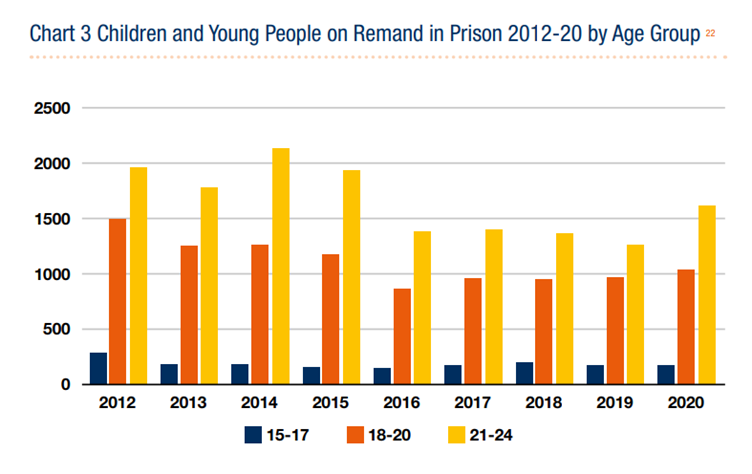
Although the number of young adults remanded to custody has fallen over the last ten years, as the Commons Justice Committee makes clear, there has been a worrying upward spike recently – one which may have lasting consequences.
T2A’s 2021 ‘Young Adults on Remand’ report by criminologist Rob Allen highlighted just how traumatic and disruptive a remand in custody can be for young adults. The report shed important light on how the use of remand increases significantly as a young person turns 18.
What’s also concerning is that the support for remand prisoners in prison and on release is almost non-existent. Without this specialist support, young adults in particular are less likely to have positive outcomes.
The case for an independent review
T2A endorses the Commons Justice Committee’s proposal for an independent review into whether the application of the Bail Act 1976 is still operating as intended. T2A believes that young adults should be an integral focus of the review. A period of imprisonment at such a young age is severely disruptive and can have even more impact on young adults than for older prisoners.
Racial disparity and the need for data
The CJC highlighted the lack of available published data. According to the report, data on the ethnicity of the remand population is only released every two years, though the data is collected internally and could be made available. T2A endorses recommendation four in the CJC report, that data on ethnicity be published regularly to monitor bail and remand decision-making, particularly in respect of young adults.
Our report in 2020 showed a clear disparity in decisions about those remanded to custody in Crown Court cases, with one in five of all those remanded in 2019 coming from Black and Minority Ethnic communities. More troubling still is despite Black defendants being more likely to be remanded into custody from the Crown Court, they are less likely than white defendants to go on to receive an immediate custodial sentence at the conclusion of proceedings.
The CJC report says:
“It is only on the basis of good quality data in respect of the use of custodial remand that there can be effective policy-making.
“More data needs to be collected and published on remanded defendants, particularly in relation to the reasons for refusing bail, the length of time people are spending on remand as well as demographic information, including vulnerabilities and protected characteristics amongst the remand population, to increase transparency and improve the information available to decision-makers.”
Ongoing T2A work on young adults and remand
T2A is currently supporting a new Howard League project which will shine a spotlight on the reality of the lived experiences of young adults on remand.
The work will build upon previous work by Howard League on Sentencing Principles for Young Adults (Jan 2019) and the Remanding children to prison report (Sept 2021) as well as the findings from the Rob Allen 2021 report. The Howard League project will:
- identify the reality of the lived experiences of young adults on remand,
- support young adults and professionals working with them to better understand the law and their rights that are relevant to remand decision-making,
- identify key areas for policy and practice improvement to reduce the number of young adults remanded to custody,
- and improve the experience of those who cannot be released.
- Ultimately the project will share the learnings from its work with practitioners, policymakers, and those making remand decisions to ensure the best outcomes for young adults.

To find out more about the T2A evidence base, visit our Research and Reports page.
Research and reports 12 January 2023
T2A Chair Leroy Logan MBE reflects on report highlighting racial disparities
Courts and sentencing, Race and ethnicity, Young adultsAs we start the new year, the chair of the T2A Alliance Leroy Logan MBE reflects on a key 2022 report from Sheffield and Manchester Universities: Young adults in court: shrinking numbers and increasing disparities
A recent report from the Sheffield and Manchester Universities found that, over the last ten years, the number of young adults appearing in court has reduced significantly. In theory, this news should be warmly greeted, but the factors behind this reduction are not yet fully clear.
And while the rate of custodial sentences among young people has fallen by 40%, it’s still twice as high as for those over 24 years of age – and 12 times higher than for those who are under 18.
Young adults continue to be over-represented in the criminal justice system, and that’s why it’s crucial that we employ a distinct approach to their unique needs. When we get these interventions right, we know that young adults are less likely to reoffend and have a better chance of making a positive start to life after release.
The report authors, Nathan Hughes and Todd Hartman, also highlighted the widely varying rates of court appearances across England and Wales. In 2017-18, 8.4 per one thousand young adults in Devon and Cornwall made a court appearance. By contrast, the rate of appearances in the area covered by the Metropolitan Police was 23.1. What is causing this disparity in rates?
Unfortunately, insufficient data is available to compare the practices of different areas. If regional data was recorded in more detail, we could better understand the variations in local practice – and how these learnings could be applied nationally .
Race and ethnicity featured prominently in the report too. Hughes and Hartman found that ‘non-white’ young adults are now appearing in court and being sentenced to immediate custody at 1.7 times the rate of ‘white’ young adults. What’s even more concerning is that this gap has grown in the last ten years.
It’s equally challenging to understand the full picture here as data on ethnicity only started to be recorded in 2009-10, and the population size of each ethnic group is estimated – hence the use of the imprecise terms, ‘white’ and ‘non-white’, in this report. The authors quite rightly call for more robust monitoring of data on ethnicity, which T2A fully supports.
It’s only with access to this data that we can begin to properly address the significant disadvantages faced by young Black and minority ethnic adults. Here at T2A, we remain committed to ending the racial disparities that impact the lives of young people in the criminal justice system. They deserve much better, and we will continue to do everything we can to achieve this.