2 July 2026

The Ministry of Justice yesterday announced an independent review of the prison system, led by former Home Secretary the Rt Hon Amber Rudd (1 July 2026). The review will examine security risks, safety (including violence, self-harm and overcrowding), capacity pressures, and workforce challenges. It will also consider how wider factors, including socio-economic issues and sentencing trends, are compounding pressures on the prison system.
We welcome this timely review and look forward to sharing the extensive body of evidence that T2A has gathered over the past twenty years. Our work shows how young adults, in particular, are not safe in prisons, experiencing high levels of violence and self-harm.
The review aims to ‘identify practical and deliverable options for reform to improve the resilience, performance and effectiveness of prisons, and will build a robust evidence base to support long-term decision-making and future investment’. Our research shows how taking a distinct and age-appropriate approach to young adults in prison can help to support these objectives. This work has informed recommendations made in our recent submission to the Justice Committee, including piloting young adult wings in prisons.
Upcoming work
Additionally, two new pieces of work are underway that can offer valuable evidence for the review to consider:
Reimagining custody for young adults in HMP Swinfen Hall
Taking place in HMP Swinfen Hall, this project will draw on in-depth input from young adults in custody and staff to consider how a new regime could better meet the needs of this cohort. This work aims to improve staff development, safety, and rehabilitative outcomes.
Building a better approach to young adults in custody
Prison Reform Trust are undertaking a comparative research study of existing custodial models for young adults. Early findings are expected in Autumn 2026.
Further, we hope the review will carefully consider the recent findings of T2A Alliance members Centre for Crime and Justice Studies and Prison Reform Trust, who found that although the young adult population in prison is decreasing, those who come into prison are serving far longer sentences – often indeterminate and life sentences, with a lack of age-appropriate support and poor access to purposeful activity.
We know that many reviews have come before this, and failed to enact tangible change. We urge the Government to break this cycle of prison crises, and utilise this review’s findings to firmly tackle the unique challenges that young adults are facing in prison. This is an important opportunity to implement generational change to ensure future cohorts of young adults experience genuine rehabilitation in prison, leading to reduced reoffending and greater public safety.
24 June 2026
Join our Young Adult Advisory Board
Advocacy, Lived experience, Young adults
We’re recruiting to a Young Adult Advisory Board.
We are looking for a group of young adults to inform the strategic direction of our work, develop our campaign asks, represent us across a wide range of policy, practice and professional settings, and communicate the value of our work.
- Are you a young adult aged 18-25?
- Have you had experience of arrest, courts, prison, probation, or parental imprisonment?
- Are you passionate about making a change to systems and services, to improve things for other young adults?
If so, we want to hear from you.
If you are appointed to this Board, you will be reimbursed for your time in working with us, in line with the Real Living Wage.
View the flyer here, and apply using the application form here.
For more information, please contact Lavinia at lavinia@spark2life.co.uk, who is overseeing this work.
20 May 2026
T2A’s take on the Youth Justice White Paper
Courts and sentencing, Diversion, Young adults
On 18 May 2026, the Ministry of Justice published a White Paper on youth justice, outlining reforms to the youth justice system alongside a delivery plan. Titled ‘Cutting Youth Crime, Changing Young Lives,’ the proposals set a clear ambition to prioritise early intervention, rehabilitation, and reduce the number of children in custody. It is positive to see growing recognition of the needs of young adults within this White Paper, however, for this cohort, it stops short of dedicated action. The White Paper states its provisions represent a ‘once-in-a-generation reform of youth justice in England and Wales’, and yet, the provisions do not go nearly far enough in providing a clear vision to reimagine justice for children or young adults.
Whilst the proposals recognise the distinct needs of children, requiring a different approach to adults, we’re disappointed that yet again, the cut-off of services and support at 18 is perpetuated, despite the overwhelming neuroscientific evidence that brain maturation, particularly in areas governing impulse control, risk assessment, and emotional regulation, continues well into the mid-twenties.
A youth justice system that invests in child-centred, developmental approaches and then abandons them the moment a person turns 18 is not evidence-based.
Early intervention and Diversion
T2A’s position is clear: action taken at the point of a custodial sentence is action taken years too late. We welcome focus on prevention, early intervention, and diversion, as key pillars to meaningfully reduce the number of children coming into contact with the criminal justice system. For this reason, the extension of the Turnaround programme is positive, in its support of a voluntary, relational model. However, the scheme must not solely be offered through Youth Offending Teams (YOTs), as it signals a child is already on the cusp of offending or has already offended. To need to get to this point to access support is to act too late. Some of this funding should be diverted to community and grassroots organisations that can engage with families and caregivers well ahead of the point of offending, and prevent, intervene early or divert before they ever get to the attention of the police or YOTs in the first place.
Further, we call on the government to develop an equivalent scheme for young adults at the cusp of the adult criminal justice system, funded through the proposed Youth Justice Innovation Fund. The out-of-court resolution reform consultation should explicitly provide for a young adult framework, including a statutory young adult conditional caution with a mandatory developmental assessment component, and a deferred prosecution scheme for 18 to 25 year olds modelled on successful youth schemes.
Young Futures Hubs, which already extend to age 24 in cases of special educational needs and disabilities, or vulnerabilities, should explicitly include justice-involved young adults in their eligibility criteria, with Youth and Young Adult Justice Service transition workers co-located on site.
Courts and Legal Process
The commitment to review the function of criminal courts for child defendants is welcome, particularly the consideration of whether young adults might benefit from a similar process. T2A asks that this review explicitly includes young adults aged 18 to 25 in its terms of reference, drawing on international evidence of young adult courts, and considers piloting a young adult intervention court pathway running alongside the proposed Youth Intervention Courts.
We also ask that the mandatory specialist training proposed for lawyers representing children is extended to cover defendants aged 18 to 25, with training materials focused on neurodevelopmental evidence and young adult vulnerability.
Sentencing
Whilst T2A strongly supports the move away from short custodial sentences and the strengthening of community alternatives for children, we know that sentences for young adults are getting longer and longer. The data may show decreasing numbers of young adults coming through the system, but for those who are still impacted, the process is getting tougher.1 T2A have long called for the establishment of young adults as a distinct statutory cohort within the criminal justice system through an ‘Emerging Adult Transition Status’, with specific sentencing protections, similar to that of children.
We ask that sentencing guidelines are amended to require courts to consider neurodevelopmental maturity, not age alone, as a mitigating factor for all defendants under 25, and that statutory maturity assessments are available at sentencing for this age group. We also ask that the presumption against short custodial sentences being developed for the youth estate is extended to the 18 to 25 cohort.
Remand
We know that many children and young adults who are remanded to prison are eventually either acquitted or given a community sentence. In 2024, 441 children who were in custody awaiting a hearing did not end up receiving a custodial sentence, and another 168 children had their case dismissed altogether.2 For those who have been languishing in prison for months, even years, this is not justice.
The 25 per cent reduction target for unnecessary custodial remands is therefore welcome, and we urge its extension to young adults. Although fewer young adults are going through the courts, those that do find themselves in court for more serious offences are increasingly more likely to be remanded in custody and to receive custodial sentences, and less likely to receive community sentences.3
T2A calls for the community remand alternatives funded under this programme to be made available on a step-up basis for 18 to 25 year olds entering the adult system, and that a statutory transition planning meeting is required for any young person who turns 18 while on remand.
Crucially, reviewing racial disproportionality within remand decisions must include 18 to 25 year olds.
We know remand disproportionately impacts Black and racially minoritised children and young adults: in June 2023, 26 per cent of remanded 18-20-year-olds and 18 per cent of remanded 21–25-year-olds were Black, compared to less than six per cent and five per cent respectively in the general population.4 It’s critical to consider Gypsy, Roma and Traveller young adults within scope of this too. Gypsy, Roma and Traveller young adults are disproportionately remanded to custody, and face some of the worst disparities and outcomes within the criminal justice system, although hesitancy to disclose ethnicity due to discrimination results in a significant undercount on official records.5
Further, specific attention must be given to the disproportionate impact of remand on girls and young adult women. In March 2025, over half of the young women (aged 18-20) in prison were there on remand.6 This coincides with worryingly high levels of self-harm amongst young women in prison, the overwhelming majority of whom have committed non-violent offences. We call on the Ministry of Justice to therefore expand specific consideration to young adult women.
Custody and Transition
As the youth custodial population becomes smaller and more focused on serious offences, increasing numbers of children will serve sentences extending well into adulthood. We are glad to see the White Paper acknowledge the transition from youth to adult custody as a problematic point, as was found in our lived experience focus groups for our response to the Justice Committee’s inquiry into Children and Young Adults – but we see no plan of action attached to this. Our ask is that the Youth Custody Transformation Plan include a dedicated chapter on transition to the adult estate, with statutory joint planning between youth custody and the adult prison service from at least three to six months prior to transfer.
Further, in line with our recommendation made to the Justice Committee, T2A asks the Ministry of Justice to pilot a young adult wing model in the adult estate adjacent to youth custodial sites. It is necessary for this wing to be carefully co-designed with young adults themselves, for young adults to have access to older peers – who, according to lived experience focus groups – can provide a calming influence on the wing – and a dedicated trauma and culturally responsive, developmentally appropriate regime, with continuity of staff and therapeutic relationships, alongside meaningful access to education, employment and entrepreneurial opportunities.
Annmarie Lewis OBE, Head of Criminal Justice at Barrow Cadbury Trust:
“The central ask of T2A is clear: the developmental, rehabilitative principles underpinning this White Paper should not stop at age 18. We must consider children and young adults together, because their experiences are fundamentally connected. We cannot understand young adults in the justice system without examining the pathways that led them there, just as we cannot speak about children without recognising where those pathways so often end. This is not two separate challenges, but a single journey – a shared pipeline. Every cliff edge at 18, every point at which we withdraw developmentally informed support, reflects a conscious policy choice with real and measurable human consequences.
We urge the government to commission a companion Young Adult Justice Strategy that cuts across prisons, courts, probation, policing and prevention services, and to ensure that every reform set out here – in courts, sentencing, remand, records, diversion and custody – is explicitly considered for application to young adults.
But we need to go further. To keep focusing on solutions at the latter end of the system – where the most harm is concentrated – to the detriment of investment into schools, local communities, tackling poverty, and youth and community provision, is to let both children and young adults down. What we need is a fundamental reimagining of justice, and that must coincide with a diversion of funds from the custodial estate into investment into the voluntary and community sector, alongside a cross-departmental effort to improve the lives of every child and young adult.”
- Centre for Crime and Justice Studies (2026) Smaller But Tougher ↩︎
- Childrens Commissioner (2025) “A production line of pointlessness”: Children on custodial remand ↩︎
- Centre for Crime and Justice Studies (2025) Smaller, but tougher: How the criminal justice system is processing young adults ↩︎
- Howard League (2023) What’s wrong with remanding young adults to prison: voices and lessons learned ↩︎
- Friends, Families, Travellers (2025) Trapped in the Turnstile: Gypsy, Roma and Traveller people’s experience of the criminal justice system ↩︎
- Centre for Crime and Justice Studies (2025) Smaller, but tougher: How the criminal justice system is processing young adults ↩︎
14 May 2026
Young adults are not safe in prison
Custody, Young adults
The latest Safety in Custody data confirms what we already know: young adults are not safe in custodial settings.
In our recent response to the Justice Committee’s inquiry into Children and Young Adults in the Secure Estate, we highlighted the volatility of prisons for young adults, with lived experience focus groups held by T2A confirming this:
“If you want to get support, you have to kick off, it’s the only way you’re going to get their attention. It’s like they’re encouraging that chaos and violence” – Young adult with lived experience of custody, 2026
Safety in custody data shows that in 2025, young people aged 18-20 in prison had the highest rates of incidents where they were involved as assailants (862 per 1,000 prisoners), fighters (1,008 per 1,000 prisoners) and victims (406 per 1,000 prisoners).
But this is not just an issue of violence: the data shows that the mental strain the secure estate puts an already vulnerable cohort of young adults under leads to worryingly high incidents of self-harm. In 2024, young adults accounted for over one in five self-harm incidents in prisons.
In 2025, the highest rates of self-harm incidents in prisons were in the 18-20 age range, with 1,760 incidents per 1,000 prisoners, and 1,355 incidents per 1,000 prisoners for those aged 21-24. This figure skyrockets when taking into account young women: in the women’s estate, amongst 18-20 year olds, there were 38,859 incidents of self-harm per 1,000 prisoners. Despite making up just 8% of the women’s prison population, young women aged 18-25 made up 41% of self-harm incidents in 2025.
This crisis of mental health amongst young adults in prisons correlates with a noted lack of support, with young adults feeling alone and ‘left to fend for themselves’ despite the fear and chaos surrounding them in the prison environment.
“Moving from a YOI to an adult prison, it was daunting, it was scary. There’s no support when you do get there, you’re very much just left to fend for yourself.” – Young adult with lived experience of custody, 2026
This lack of support relates to staffing. In focus groups held by T2A, young adults expressed feeling unsupported and abandoned by staff. For those transitioning from Young Offender Institutions to the adult estate, support was not carried over.
“There are supposed to be keyworkers in prisons, but I literally saw my key worker once or twice during my whole sentence. I don’t even know if she was working there, I had no idea how to find her even if I did want to talk to her.” – Young adult with lived experience of custody, 2026
“Going from a YOI to an adult prison, there was no preparation or support. I knew coming up to turning 21 that I was going to be moved, but I didn’t know when. I found out I was being moved a week in advance and was never told where I was being moved to.” – Young adult with lived experience of custody, 2026
Our response to the Justice Committee’s inquiry into Children and Young Adults in the Secure Estate makes several bold asks for the Committee and the Government to consider in addressing this urgent and dangerous state of affairs, including:
- No child or young adult, especially girls or young women, should be placed in custody except as a genuinely verified last resort where no community alternative exists.
- Where custody is unavoidable, a developmentally and gender-informed, trauma-responsive, and culturally appropriate regime must be operational, with the transition at 18 from youth to adult provision explicitly planned and fully and appropriately resourced in custody and upon release.
- The Government should legislate to establish young adults aged 18-25 as a distinct statutory cohort within the criminal justice system through an ‘Emerging Adult Transition Status’, creating a legal presumption against standard adult custodial conditions, with specific sentencing protections, custodial regime entitlements, and post-release support obligations.
- HM Inspectorate of Prisons should be given a statutory duty to inspect against a young adult specific inspection framework, and formal joint escalation protocols between the inspectorates should be set up, for establishments that fail to meet minimum standards for young adults.
- An independently evaluated programme of pilots testing dedicated young adult custodial units, including small therapeutic units and dedicated wings within adult establishments, should be commissioned without further delay, reporting findings to this Committee within two years.
T2A is calling on the Government to be bold, and take a generational opportunity to end the crises young adults in prisons are facing.
The context for the above recommendations could not be more urgent. The Government is currently investing £4.7 billion to deliver 14,000 new prison places by 2031. Without a fundamental reimagining of the system’s operational framework, this investment will compound current failings for another generation.
The overarching recommendation of our submission to the Committee was legislation to establish young adults aged 18 to 25 as a statutorily recognised distinct cohort within the justice system.
Without statutory underpinning, incremental reforms will continue to stall at the point of implementation, as they have done with marked consistency, for nearly a decade since the Justice Committee’s last inquiry into young adults.
19 March 2026
T2A’s response to reforms to the Youth Justice System
Young adults
On 12 February 2026, the Ministry of Justice published ‘A Modern Youth Justice Service: Foundations Fit for The Future’, a policy paper setting out reforms and plans to modernise the youth justice system.
The strategy set out many provisions that voluntary sector organisations, community groups and people with lived experience working within the criminal justice system have long been calling for, including:
- Increased, sustainable funding for youth justice services
- More efficient commissioning of services and interventions
- Consultation with the youth justice sector on funding and oversight arrangements
- Custody as an absolute last resort for children
- Increased and longer-term investment into alternatives to custody, using a rewards-based system.
T2A welcomes these reforms, particularly a funded commitment to alternatives to custody for children, and a recognition of the value and expertise of voluntary sector organisations working to support children, through sustained and considered investment. It is commendable that this policy paper has outlined what many in the sector have been saying for years: that children who remain in custody have been failed repeatedly by the state, and that there is a concerning trend towards racial disproportionality within the youth justice system. Institutional recognition of these systemic issues is the first step in reversing these injustices.
However, commitments like these can only go so far when they are effectively redundant as soon as a child turns 18. T2A has consistently highlighted the neuroscientific evidence demonstrating that full maturation is not achieved until at least age 25, and that those aged 18-25 face a cliff-edge of support when transitioning into adulthood. Approaches that prioritise safety, support and care rapidly devolve into those of punishment and stigma, despite young adults having significant capacity for desistance with the right approaches, like those laid out within these reforms.
That is why we urge the Government to be bold and extend this strategy to young adults. In 2016, in our submission to the Justice Select Committee’s inquiry into young adults in the criminal justice system, we called for a distinct national approach. The Committee adopted this as its principal recommendation, though it was never formalised by government. Ten years on, with a new parliamentary inquiry underway, we have a renewed opportunity to focus on young adults, and we hope the Government and the Ministry of Justice will seize this moment for change and work to significantly reduce the number of young adults coming into contact with the criminal justice system.
Annmarie Lewis OBE, Head of the Criminal Justice Programme at Barrow Cadbury Trust, said:
“The outlined reforms to the youth justice system are a strong example of the crucial and positive changes that can be enacted when children – and the sector that works with them – are listened to, sustainably funded, and supported. This is a strategy seeking to invest in what works, and we hope that the Government will continue its progress by following decades of evidence that show how transformative it could be to apply a similar and distinct approach to young adults.”
27 February 2026
T2A’s take: A new model for policing
Diversion, Policing and arrest, Young adults
On 27 January 2026, a White Paper ‘From local to national: a new model for policing’ was published, setting out a series of sweeping reforms to policing. In proposals described by the Home Secretary, the Rt Hon Shabana Mahmood MP as ‘the most significant modernisation in nearly 200 years’, several changes could serve to significantly alter the oversight, governance, and day to day function of policing in England and Wales.
Key changes
- The creation of the National Police Service (NPS), incorporating agencies including the National Police Chiefs’ Council, the College of Policing, the National Crime Agency and Counter Terrorism Policing into a single organisation to focus on serious and organised crime, and threats to national security. This proposal seeks to ‘lift the burden of delivering national responsibilities from local forces, ensuring that their focus is entirely on policing their streets.’
- A substantial reduction in the number of local forces, possibly by altering force boundaries and merging existing forces into fewer, larger forces. There are currently approximately 43 local police force areas across England and Wales. The White Paper states that an independent review will be undertaken into force structures, resulting in a significant reduction to the number of forces by the end of the next Parliament.
- The abolition of Police and Crime Commissioners (PCCs) by 2028, to be replaced by Strategic Authority Mayors and local council leaders through Policing and Crime Boards. Over time, these Boards will be adapted to provide the governance of future fewer, larger police forces.
- Creation of Police.AI, a new centre for the utilisation of Artificial Intelligence (AI) powered tools and software within policing to automate manual processes.
What does the White Paper say about young adults?
The White Paper proposes to continue investment into the Young Futures Programme through Young Futures Hubs and Prevention Partnerships, to reduce the involvement of young people in crime. Highlighting the importance of early intervention, the proposals reference Violence Reduction Units and the County Lines Programme as interventions that prevent young people from being drawn into crime and reduce knife crime.
What is the Young Futures Programme?
The Young Futures Programme is a government-led programme consisting of Young Futures Prevention Partnerships and Young Futures Hubs, described in the National Youth Strategy as a ‘new approach to tackle knife crime and violence.’
Young Futures Prevention Partnerships ‘identify young people vulnerable to being drawn into crime at local authority level and provide them with support at the right time’, through multi-disciplinary panels run in Violence Reduction Unit (VRU) areas. These Panels will aim to prevent crime and engage in early intervention by identifying and referring young people at risk of crime to a range of different support services, including the Young Futures Hubs.
Young Futures Hubs aim to bring together services to improve access to opportunities and support for young people at community level. In July 2025, the Prime Minister set out plans to open 50 hubs over the next four years. £2 million has been made available to eight local authorities this financial year to design and implement ‘early adopter’ Young Futures Hubs, in: Nottingham, Tower Hamlets, County Durham, Manchester, Birmingham, Brighton and Hove, Bristol, and Leeds.
Our view
Despite welcome language around prevention, our concern remains that an over-investment in policing to the detriment of well-funded, community-based children and young adult provision continues to entrench feelings amongst young adults of being overpoliced and disinvested in. Instead, the police should support diversions from the justice system for young adults, and maximise opportunities to move away from crime and develop positive identities as they navigate the transition to adulthood.
The ‘bobbies on the beat’ community policing angle, referenced within the White Paper with the commitment to deliver 13,000 additional neighbourhood policing personnel in police forces across England and Wales, comes from a place of viewing increased police presence as a safety measure, ignoring the reality that many young adults – particularly marginalised and overpoliced communities including racially minoritised people, girls and young women, those with care experience and people from socioeconomically deprived communities – feel less safe, and even victimised by the police. Work to divert young adults away from the criminal justice system cannot be relegated to a specific programme or pilot, but rather requires a whole-systems approach and a rethinking of police contact and response tactics. T2A advocates for the police to receive specific training for managing contact with young adults, particularly on stop and search and when making arrests, and that innovative diversion programmes delivered by grassroots, community-based organisations are commissioned and sustainably funded by the Strategic Authority Mayors and Policing and Crime Boards that will come to replace PCCs.
The increasing reliance on AI within policing is a cause for serious concern. We already know the racialised nature of facial recognition tools, and the impact this has had on community relationships and trust and confidence in the police, particularly amongst young adults. In a recent visioning workshop with T2A alliance members, supporters, and partners, participants were fearful of algorithmic bias in tools used for risk assessment, sentencing recommendations, and predictive policing, noting that these systems often rely on historical data that reflect existing inequalities, such as over-policing in certain communities. Only recently, a man of South Asian heritage was arrested in Southampton on suspicion of burglary as a result of a facial recognition error, despite being 100 miles away from the scene in Milton Keynes, and the suspect looking ten years younger. Without careful design and oversight, AI tools can reinforce and perpetuate racial biases. T2A workshop participants called for pre-emptive reform to prevent embedding discrimination into automated decision-making.
Looking forward
Our vision is to create a blueprint for a justice system that sees young adults not as problems to be solved or issues to be fixed, but as people shaped by their experiences with incredible capacities to progress, grow, and change. Policing structures, responses and adjoining programmes need to reflect this sentiment, and reform not only their geographic boundaries and use of technology, but approach to young adults from a perspective of compassion and guidance, rather than criminalisation and surveillance. T2A is concerned that reform that is not co-produced with communities will have little positive impact, and hope that the implementation of these proposals includes close consultation with young adults with experience of police contact and the organisations that work with and support them.
18 February 2026
T2A’s take: The Sentencing Act
Sentencing, Young adultsOn Thursday 22 January 2026, the Sentencing Act received Royal Assent – marking the most significant shift in sentencing law in years. Many of the changes were taken forward from recommendations made to the independent Sentencing Review, led by David Gauke, which T2A responded to in full last year.
Although it is now set out in law, many of the provisions will take time to come into force.
Key changes
The main changes relevant to T2A’s work include:
- Deferment of sentences (delaying the imposition of a prison sentence in favour of a suspended sentence or community order, subject to compliance with requirements, such as drug treatment) increased from six to 12 months.
- The introduction of a presumption to suspend prison sentences of 12 months or less; combined with more stringent licence conditions after release, with closer supervision in the community.
- Changes to community sentence requirements including expanded use of curfews, exclusion or restriction zones, tagging, behaviour requirements and rehabilitation conditions.
Our view
The provisions in the Sentencing Act marked a series of missed opportunities to take a bespoke approach to young adults to ultimately divert them away from the criminal justice system at a developmentally crucial point in their lives. Our position is that the criminal justice system, as it currently operates, is not fit for purpose to meet the distinct and pressing needs that young adults have, and that it serves as an institution of harm rather than rehabilitation.
Despite this, there are provisions that we are largely in agreement with. In our response to the Sentencing Review, we acknowledged that deferred community sentences and other forms of diversion are ways to alleviate the pressures on the system, and we are pleased to see more credence given to these options within the Act.
Deferred sentences
The increasing of the time allowed for a deferred sentence is positive – we recognise that for many young adults, positive change can take time, to allow for the processing of trauma; the effects of poverty; problems with drugs and alcohol; mental ill health; experiences of domestic abuse; and violence. Working with young adults to overcome these challenges is not an overnight fix, therefore we welcome to increase in the time to defer sentences.
Custodial sentences
Whilst it is a positive step in the right direction to introduce a presumption to suspend short prison sentences – particularly for those engaged in low-level crime due to unmet needs – we know that young adults continue to be disproportionately overrepresented in custody1, those who continue to receive custodial sentences are receiving even harsher treatment.
Since 2010, average sentence lengths for young adults rose from 16.3 to 24.5 months2, and racial disproportionality widened rather than narrowed – Black young adults now appear in court at three times the rate of white counterparts3 and receive sentences 80 per cent longer on average4. The rate of immediate custodial sentences for young adults remains twice as high as for those over 24, and has risen to more than 12 times higher than for under 18s.5 This means that many young adults will be out of scope to benefit from the move away from short prison sentences, because they are above the 12-month threshold.
T2A is disappointed that the opportunity for a specific young adult sentencing framework for 18–25-year-olds was missed from these reforms. T2A has consistently highlighted long-standing neuroscientific evidence on the maturation of young adults, which shows that the brain remains in an active state of development until about 25. In practice, this means that young adults have not fully developed the cognitive abilities which are necessary for prosocial behaviour, and are more likely to have immature and compromised core cognitive abilities, including poor impulse control, and engagement in risk-taking behaviours.
Despite the maintaining of the status quo within this Act, we continue to advocate for a separate statutory sentencing framework for young adults, akin to that for children, reducing the lengths of adult sentences by a certain proportion, in line with T2A’s substantial evidence base demonstrating the unique needs and experiences of young adults.
Community sentences
Although court appearances for young adults fell by 76 per cent between 2007 and 2019,6 those who do find themselves in court for offences classified as serious have been increasingly more likely to receive custodial sentences, and less likely to receive community sentences. Provisions within the Sentencing Act to prioritise community sentences over short custodial sentences, and longer deferred sentences, are welcome, though we have concerns about an increasingly punitive approach to community sentences, including expanded use of curfews, exclusions or restriction zones, and tagging.
T2A’s view is that there is scope to develop young adult-specific community orders as part of a distinct framework, linking in with the above proposal for a separate statutory framework for sentencing young adults. An approach specifically for young adults should be grounded in therapeutic principles, supporting identity shift and the development of social capital – particularly belonging – alongside purposeful activity. Learnings can be taken from existing or previously existing initiatives, such the Youth to Adult (Y2A) Hub in Newham, London: a multi-agency hub for all young people on probation integrating support with drugs and alcohol, emotional wellbeing, restorative justice and housing (amongst other things) under one roof; or the Intensive Alternative to Custody (IAC) pilot programme in Greater Manchester, which targeted young adults aged 18-25 who were at risk of short–term imprisonment by combining intensive probation supervision with various interventions, including education, employment support, and mental health services.
Our concern is that by focusing on punitive and restrictive elements of community sentences, such as curfews, exclusion zones and electronic monitoring, we lose the opportunity to implement developmentally-appropriate community solutions for young adults that address the root cause of their involvement in crime, that can serve to prevent reoffending and enable young adults to break free from cycles of harm.
We also know that many community services have a long way to go in terms of being gender-specific, anti-racist and culturally competent, and would like to see increased funding for community services diverted to small, specialist organisations who are able to deliver support to racially minoritised and marginalised young adults, and who operate in heart of their communities.
Looking forward
Ultimately, our vision includes legislation and policy around young adults and criminal justice to be centred around a mission-led, system-wide shift away from punitive, ‘one-size-fits-all’ adult-oriented sentencing, and moving towards a wraparound, tailored, developmentally informed approach for young adults. Over the last few months, we’ve been busy co-creating a vision and blueprint that reimagines and transforms justice for young adults, in partnership with practitioners; young adults with lived experience; academics; and private, public and civil society organisations. Together, we’ve been deliberating on how we achieve a shared goal: reimagining ‘justice’ not merely as punishment, or retribution – but as a way forward, grounded in fairness, care, accountability, and renewed hope for all.
For young adults, this is about far more than sentencing: it is about whether the system continues to compound existing trauma, particularly by placing them in criminogenic institutions widely regarded as not fit for purpose, or instead responds in safe, evidence-based and trauma-responsive ways that recognise experiences of harm, the capacity for change, and the importance of proportionate accountability. Getting this right will not only shape individual futures, but strengthen the safety and wellbeing of our communities.
1. Hughes, N. and Hartman, T. (2022) Young adults in court: shrinking numbers and increasing disparity https://t2a.org.uk/wp-content/uploads/2022/10/Young_Adults_Report_in_Court.pdf
2. Centre for Crime and Justice Studies (2025) Smaller, but tougher: How the criminal justice system is processing young adults https://barrowcadbury.org.uk/wp-content/uploads/2025/07/CCJS-YoungAdultReport-July2025-1.pdf
3. Ibid.
4. Revolving Doors (2020) Racial bias is pulling Black young adults into an avoidable cycle of crisis and crime https://revolving-doors.org.uk/racial-bias-pulling-black-young-adults-avoidable-cycle-crisis-and-crime
5. Hughes, N. and Hartman, T. (2022) Young adults in court: shrinking numbers and increasing disparity https://t2a.org.uk/wp-content/uploads/2022/10/Young_Adults_Report_in_Court.pdf
6. Ibid.
25 July 2025
Shaping Justice Together: A New Vision for Young Adults
Young adults
If you’ve been following our work, you may have noticed a pause in updates from the criminal justice programme and T2A. But that pause wasn’t silence, it was reflection. A moment to listen, learn, and recalibrate.
Since stepping into this role last November, I’ve had the privilege of immersing myself in the legacy of T2A, while continuing the journey I’ve been on for over 30 years as a pioneer and champion in the broader justice reform movement. And in recent months, it’s become clear: we’re at a crossroads.
We’ve seen policy shifts that feel more reactive than reflective. The Sentencing Review included some welcome progressive elements, but we were disappointed that it failed to recognise young adults as a distinct group with specific needs, despite our substantive submission . This omission, alongside the Sentencing Council’s new guidelines, reflects a troubling trend, the adoption or manipulation of a ‘two-tier justice’ narrative – the notion that women, racially minoritised, and other marginalised groups receive preferential treatment through the criminal justice system. The evidence, however, does not support this contention.
For decades, underrepresented groups have experienced a two-tier system in practice, a reality that has driven long-standing campaigns for racial and gender justice. The current political weaponisation of this rhetoric is not only flawed, but unsafe. It risks undermining progress, embedding regressive policies, and distorting public understanding of justice reform. We must challenge this narrative with clarity, truth, and strategy.
A Time to Rethink, Reframe and Reimagine
This isn’t about despair, it’s about direction. We’ve taken a step back to ask: What does justice look like for young adults today? And more importantly: Who gets to shape that vision?
That’s why we conveneda powerful and diverse group on 30 June—people from different communities, professions, and lived experiences, each bringing their own insights and passions—for a day of deep conversation, bold imagining, and commitment to radical change.
Our workshop, Shaping Justice Together: A New Vision for Young Adults, was more than an event, it was a powerful moment of collective intention. A call to co-create a new blueprint for a justice system that sees young adults not as problems to be solved or issues to be fixed, but as people shaped by their experiences, many of whom have lived through significant harm. We aim to develop a vision that embraces the full complexity of young adult lives without diminishing it, that doesn’t ask what’s wrong with you, but rather what happened to you, and seeks to restore, not erase, the humanity of everyone involved.
Imagine a system that understands the duality of being both survivors and, at times, agents of harm. One that recognises their actions, choices and behaviours cannot be separated from the contexts they’ve lived through, often shaped by trauma, inequity, and unmet needs.
Imagine an approach that holds space for healing, accountability, and restoration, not only for young adults, but also for those impacted by their actions. One that believes growth is possible, change can happen, and reconciliation can emerge when the right care and support are in place.
Now imagine a system that not only recognises the dual nature of state and social harm—where children and young adults can be harmed by state agencies as well as by social inequality—but also begins to disrupt these cycles. Dismantling the school-to-prison pipeline: the systemic pattern where disadvantaged young people, particularly from racialised communities, are pushed out of education and into the criminal justice system. And beyond that, recognising the growing reality of the prison-to-prison pipeline: the ways in which prisons themselves become criminogenic spaces that deepen harm and entrench cycles of offending, not only for young adults inside, but also for the young adult staff working within them.
Alarmingly, we are seeing increasing numbers of young staff committing offences, particularly within prison environments, and crossing the threshold from employee to prisoner themselves—caught in the very system they once served. These are not isolated incidents; they are symptoms of the acute trauma and the substantial challenges facing a highly stressed and often demoralised workforce, highlighting a system in urgent need of transformation. Our young adult staff, many of whom carry their own lived experience, need the same care, compassion, support, safety, and accountability to do this work well. Healing must be systemic, not selective. We need a system that understands justice isn’t just about those impacted by it, but also about those working within it.
This is a call to reimagine justice not as punishment, but as a pathway forward, rooted in fairness, compassion, responsibility, and renewed hope for all.
Narrative Change: From Harm to Healing
This is not just a shift in language, but a shift in values, and a focus on what works. A move from harm to healing, from isolation to inclusion, from conflict to connection. One that honours young adults’ potential, rather than simply punishing their mistakes, and strengthens the communities around them, rather than further tearing them apart.
We’re not alone in this. Across the sector, funders and partners are coming together to challenge harmful rhetoric and build a shared strategy for narrative transformation. The idea of a ‘two-tier justice system’ that favours women or other disadvantaged, marginalised, and underrepresented groups isn’t just misleading, it’s dangerous. It obscures the structural inequalities that have long defined our justice system, particularly for young adults from racialised and marginalised communities, including young women and girls.
We’re working closely with the Corston Independent Funders Coalition, the Harm to Healing Coalition, and UK narrative change with partner funders, to align our efforts, reduce duplication, and amplify what works. The Harm to Healing Coalition, born out of the work of Dr. Patrick Williams, Temi Mwale, and the HtH Resource Group has helped set a strong narrative focus for reimagining justice through a new lens. Because the truth is there’s incredible work happening at the grassroots. Just look at Spark Inside’s recent roundtable, which brought together young men, practitioners, and policymakers to reimagine wellbeing and racial equity in custody, building on the work of their being well being equal campaign and report. Or Daddyless Daughters, who are pioneering transformative work with girls and young women affected by family breakdown, abuse, and adversity, helping them build healthy, sustainable lives and relationships, and preventing criminal and sexual exploitation. These are just two examples of the powerful, community-rooted work that we are supporting to drive change from the ground up.
We explored the map, the model, the modus operandi, and the missing pieces and the energy in the room was electric! We’ll share key outcomes in a future blog, but for now, we’re excited to announce that the second in the series will take place in September.
What’s Next for T2A?
Over the next year, we’re focused on four key priorities:
– Synthesising 20 years of T2A evidence into a clear, actionable vision for young adult justice, and embedding systems change across policing, prisons, probation, public affairs and public policy.
– Embedding lived and learned experience at the heart of our work through a new T2A Alliance advisory panel and group.
– Advancing racial and gender justice by challenging systemic bias and centring equity in all we do
– Driving strategic communications to support the next phase of T2A and counter harmful narratives.
We know the road ahead won’t be easy. But we also know that change doesn’t come from waiting; it comes from working together to drive radical reformation and bring about total transformation. Not just of systems, but of the very vision of justice itself.
What comes next doesn’t have to be a system at all… but a radically different future rooted in humanity, safety, and love.
Annmarie Lewis, July 2025
8 July 2025
Young Adult Justice Transformed project holds first workshop
Young adultsT2A Transition to Adulthood held its first workshop last week as part of our Young Adult Justice Transformed project. The energy, ideas, and commitment to change were captured by this fabulous graphic by Raquel Duran from More Than Minutes.
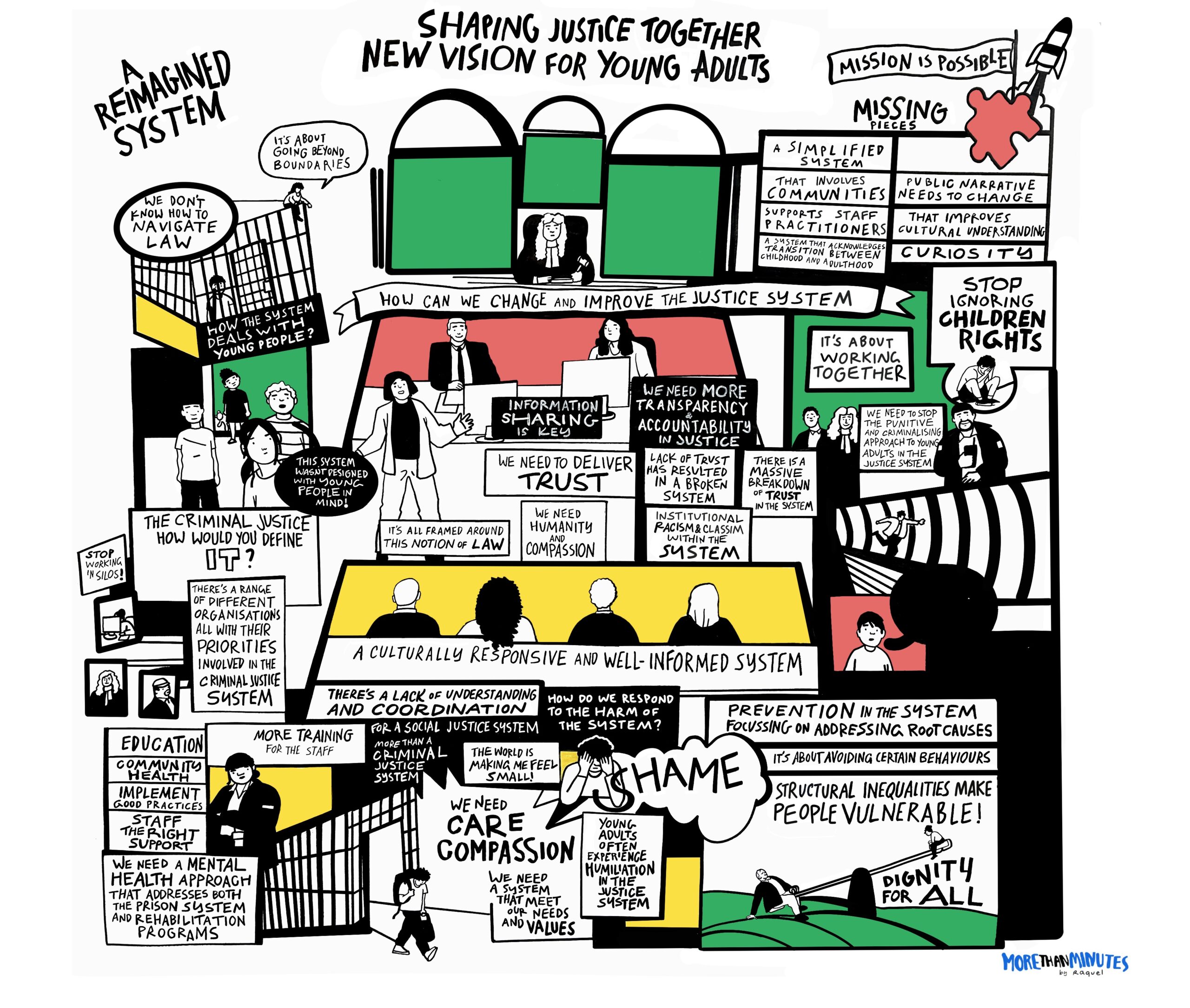
Keep an eye on this website to find out about future workshops and other T2A news. The next workshop focuses on what a re-imagined system for young adults might look like, the third will present our literature and rapid evidence review, and the final workshop will focus on developing a narrative strategy to bring about meaningful change.”
Barrow Cadbury Trust/T2A has responded to the final Sentencing Review Report. We believe there is much in this report to welcome. However, T2A is disappointed that more consideration was not given to the specific needs of, and the evidence we have amassed around effective responses to, young adults which we highlighted in our response to the consultation. Read our response to the final Sentencing Reivew Report May 2025.